
The Dopamine Baseline Paradox: Why Your Brain Sabotages Your Success
I was watching a friend of mine celebrate a massive promotion last year. He had the corner office, the salary jump, and the prestige. Two weeks later? He was miserable. He wasn’t just tired; he was physiologically depleted. This isn’t just a “mood swing.” In my research into the neural pathways of motivation, I’ve found that we are all living under a biological illusion.
We think dopamine is about pleasure. It’s not. It’s about the pursuit of pleasure. It’s the chemical of “more.” And here is the kicker: the brain doesn’t just give you a high; it demands a tax for every peak you reach. I call this The Dopamine Baseline Paradox.
The Biological Thermostat
Think of your brain like a high-tech thermostat. In neurobiology, this is known as homeostasis. When you experience something intense—a big win, a sugary snack, or a viral social media post—your dopamine levels spike. It feels incredible. For a moment, you’re on top of the world.
But the brain is terrified of extremes. To protect itself, it immediately pulls the lever in the opposite direction. It lowers your baseline sensitivity. You don’t just return to “normal.” You drop into a deficit. This is why the morning after a huge party or a major achievement often feels like a gray, sludge-filled nightmare. The higher the peak, the deeper the valley.
It’s a see-saw. When pleasure goes up, the brain puts weight on the pain side to level things out. If you keep hitting that pleasure lever, the brain gets tired of the game and simply breaks the see-saw. Now, you’re stuck in a low-dopamine state where nothing feels good. This relates closely to The Contrast Trigger, where our brain perceives value based on the immediate difference between states rather than the absolute reality.
The Pursuit is the Trap
I’ve spent hundreds of hours analyzing behavioral patterns in high-performers. The most successful people often struggle the most with depression. Why? Because they are addicted to the “pursuit.” Dopamine is released when you are anticipating the reward, not when you actually get it. Once the trophy is in your hand, the dopamine vanishes. The hunt is over. The brain stops firing.
This is why we see the “Post-Olympic Depression” or the “Post-Wedding Blues.” The brain has spent months or years in a high-dopamine state of anticipation. When the event is over, the baseline crashes. It’s a physiological debt that must be paid. In my analysis of cognitive experiments, I’ve seen this lead to a dangerous cycle: people start chasing even bigger rewards just to feel “normal” again.
How to Protect Your Brain
You can’t opt-out of biology. But you can manage the debt. When studying neurobiological resilience, I’ve noticed that the most balanced individuals treat dopamine like a finite currency. They don’t spend it all in one place. They understand that if they push too hard today, they will pay for it tomorrow.
- Intermittent Fasting for the Mind: Avoid stacking pleasures. Don’t listen to a podcast, while eating chocolate, while scrolling TikTok. That’s a dopamine nuclear bomb.
- Embrace the Friction: Do things that are hard. Cold showers, difficult workouts, or deep work. These activities actually raise your baseline dopamine over time by pushing the “pain” side of the see-saw first.
- The 24-Hour Rule: After a massive win, expect the crash. Don’t try to fix it with more stimulation. Sit with the boredom. Let the see-saw reset naturally.
We often fall for The Sleeper Effect, where certain behaviors or ideas don’t seem harmful in the moment, but their impact on our neural health grows over time without us noticing. We think one more hour of scrolling is fine. It’s not. It’s a micro-withdrawal for your soul.
The Invisible Ceiling
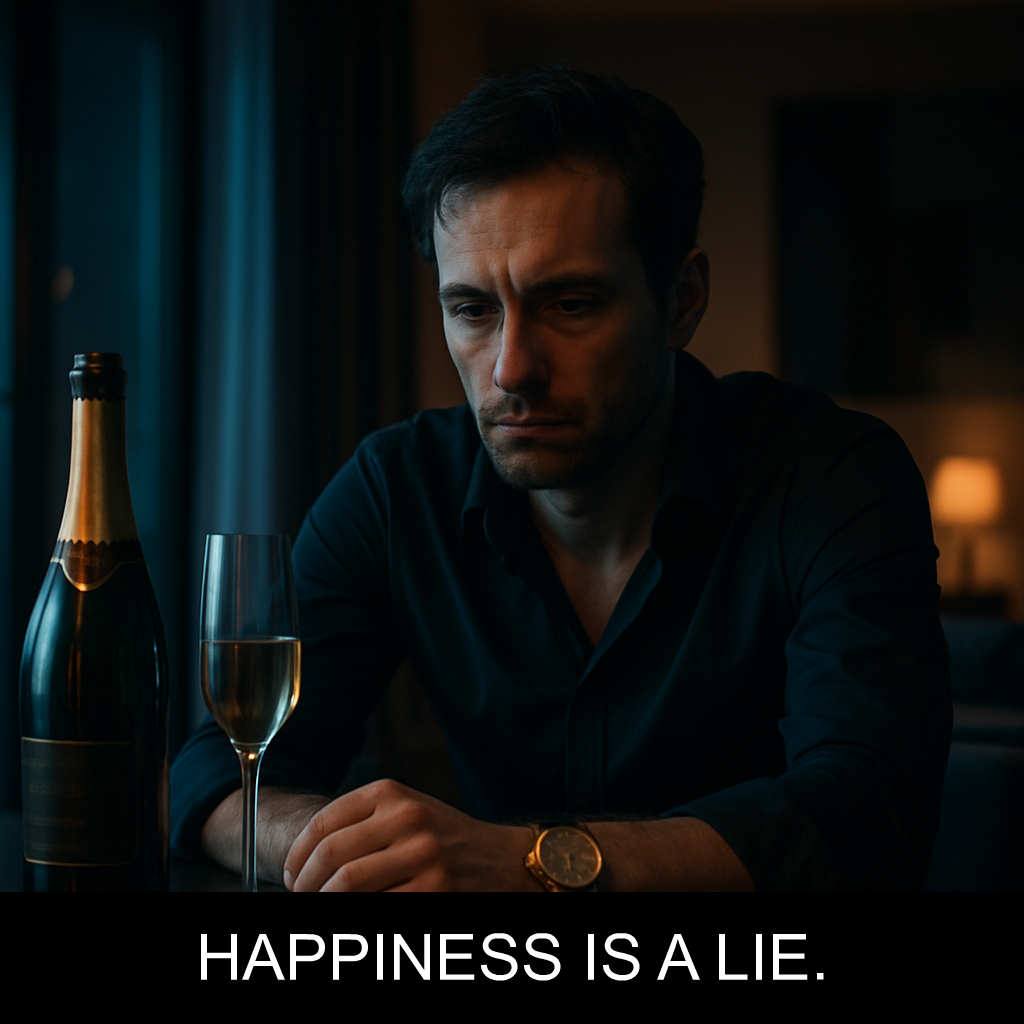
Your brain doesn’t want you to be happy. It wants you to survive and reproduce. Happiness is just a carrot it dangles to keep you moving. If the carrot was permanent, you’d stop moving. You’d be eaten by a lion or starve to death. Evolution designed you to be perpetually unsatisfied.
Is that depressing? Maybe. But there is power in knowing the rules of the game. When you realize that the “crash” isn’t a sign that your life is falling apart—but rather a sign that your brain is working correctly—you stop panicking. You stop chasing the next hit. You start finding a steady, sustainable hum of contentment instead of a jagged edge of highs and lows.
Most people are running on a treadmill that’s speeding up every day. They think if they just run faster, they’ll eventually reach the end. They won’t. The treadmill is powered by their own feet. The only way to win is to change the pace. Stop seeking the peak. Start respecting the baseline.
Are you actually ambitious, or are you just terrified of the silence when the dopamine stops?