
The Neural Erosion Effect: The Hidden Brain Rewiring That Drains Your Willpower
Ever feel like you’re being worn down? Not by a single, catastrophic event, but by a slow, steady drip of negativity. A critical boss. A passive-aggressive partner. The endless doomscroll on your phone. Each instance feels small, almost insignificant. You tell yourself to brush it off. Toughen up.
But it’s not working.
You’re more tired. More anxious. Your motivation is shot. In my research into behavioral patterns and brain function, I’ve become obsessed with this phenomenon. It’s not just in your head; it’s happening *to* your head. It’s a process I call The Neural Erosion Effect.
This is the secret, biological process by which persistent, low-grade stress physically rewires your brain to expect, and even seek, failure and threat.
What Is The Neural Erosion Effect?
Think of water dripping on a stone. A single drop is harmless. A million drops can carve a canyon. The Neural Erosion Effect works the same way on your neural pathways. Every subtle criticism, every ignored email, every worrisome headline is a single drop.
Over time, this constant drip of low-intensity stress erodes your baseline mental state. According to behavioral studies I’ve analyzed, the brain is a master of efficiency. It strengthens the pathways we use most often. When the most-used pathway is one of anxiety, frustration, or dread, the brain makes that the default superhighway. This is frighteningly similar to what I’ve observed in The Cognitive Canyon Principle, where our thoughts get stuck in familiar, deep-worn ruts.
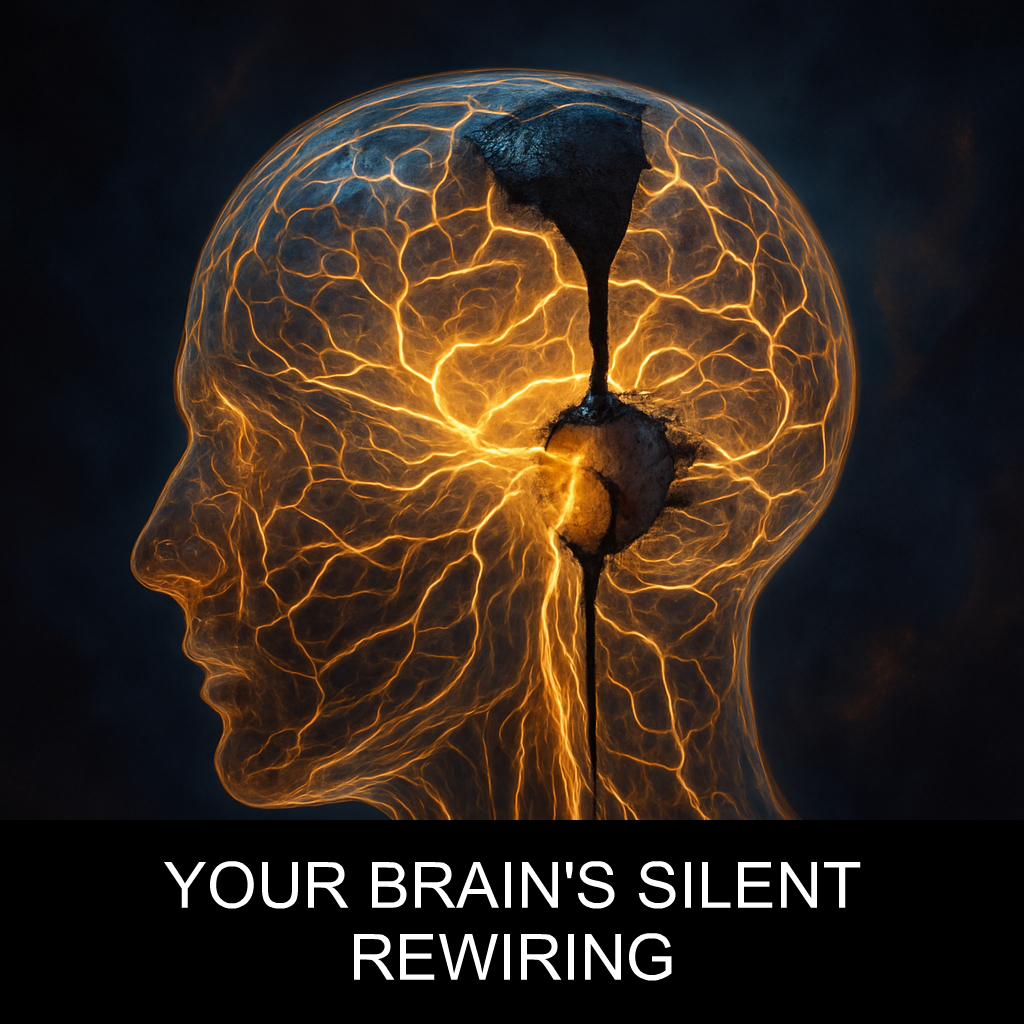
Here’s the neurobiological breakdown in simple terms: your amygdala, the brain’s little threat detector, becomes chronically overactive. It starts screaming “DANGER!” at minor inconveniences. Meanwhile, your prefrontal cortex, the center for rational thought and impulse control, gets weaker. It’s like the neighborhood watch captain is asleep on the job while the alarm system is stuck on a hair trigger. 🧠
The Science I’ve Been Analyzing: Your Brain Isn’t Loyal
Your brain’s primary job isn’t to make you happy. It’s to keep you alive. And it does this by learning from experience. This is rooted in a concept called Hebb’s Law, which I constantly see validated in social dynamics. The simple version is: “Neurons that fire together, wire together.”
When your boss sends a vague “we need to talk” email (the stimulus), and your heart pounds with anxiety (the response), you are actively strengthening the neural circuit that connects that boss with a threat response. Do this a hundred times, and the connection becomes automatic. Your brain doesn’t even wait for the full stimulus anymore; just seeing their name pop up is enough to trigger the cortisol flood.
Your brain has learned a script. This is the very foundation of The Behavioral Scripting Principle, where repeated actions become subconscious habits. The tragedy here is that the script your brain is learning is one of disempowerment and anxiety.
How Neural Erosion Shows Up in Your Life
Observed in everyday social dynamics, this isn’t some abstract laboratory finding. It’s happening right now, in countless offices and homes.
The Critical Relationship: It’s not outright yelling. It’s the constant sigh when you speak. The subtle eye-roll. The “helpful” suggestions that are just thinly veiled criticisms. Each one is a tiny drop, eroding your self-worth and training your brain to anticipate disapproval.
The ‘Always-On’ Job: It’s the Slack notifications at 9 PM. The expectation to be constantly available. Your brain never gets the signal that the threat is over, that it can stand down. It remains in a state of low-grade vigilance, slowly burning through your cognitive resources.
The Digital Drip of Doom: Every time you scroll through bad news, political outrage, or curated images of lives better than yours, you’re administering a tiny dose of cortisol. You’re teaching your brain that the world is a dangerous, inadequate place. It’s a voluntary form of Neural Erosion.
Reclaiming Your Brain: How to Reverse the Erosion
The brain that was wired can be rewired. Neuroplasticity is a two-way street. You have to become an active architect of your own mind, not a passive victim of your environment.
- Interrupt the Pattern: When you feel the familiar stress response kicking in, do something—anything—different. Physically stand up. Walk to the window. Splash water on your face. Hum a song. This tiny act of defiance prevents the old pathway from firing and strengthening. It’s a neural circuit breaker.
- Carve Positive Grooves: The old pathway is strong because it’s been used a lot. You need to build a new one. Actively schedule time for activities that fire different neurons. Gratitude, mindfulness, playing an instrument, laughing with a friend. This isn’t just self-care; it’s manual neuro-engineering.
- Install Neurological Floodgates (Boundaries): The erosion happens because the drip is constant. Boundaries stop the drip. Mute notifications after 6 PM. Unfollow negative accounts. State clearly to a loved one, “I will not engage when you use that tone.” You are protecting your brain’s real estate.
- Seek Novelty Like a Drug: The brain loves novelty. It forces the creation of new pathways. Learn a new language, try a new recipe, take a different route home from work. Novelty is the antidote to cognitive stagnation and the fastest way to weaken those overused, eroded stress channels.
The process is invisible. It’s silent. But it’s happening every single day.
What corrosive drip are you going to stop today?