
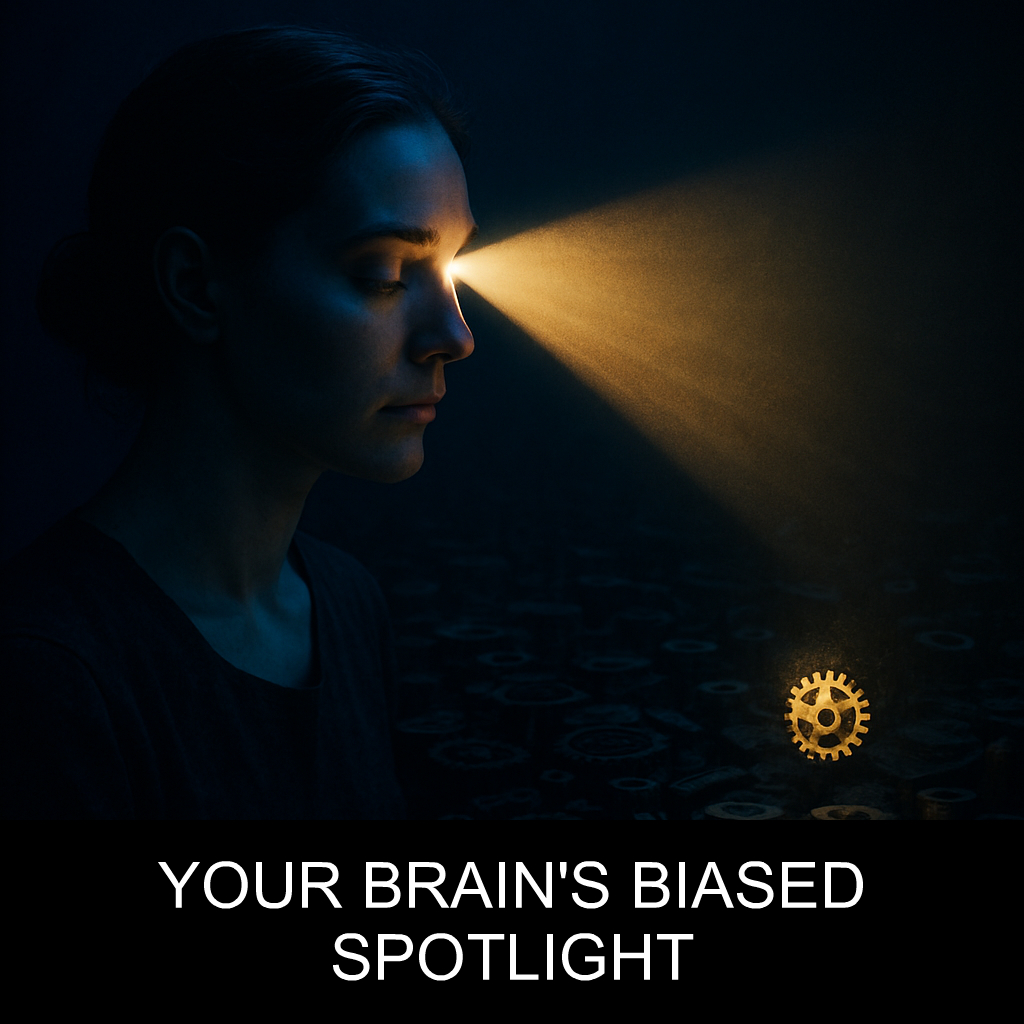

The Spotlight Fallacy: Why Your Brain Is Obsessed with the Wrong Details
You’re at a party. You have ten great conversations, share a few laughs, and connect with some fascinating people. But on the drive home, what’s replaying in your mind? That one awkward pause. That single clumsy sentence you uttered. The one moment you felt out of place. 🤦
The rest of the night—the 99% that was positive—fades into a blurry background. That 1% failure is lit up in high-definition, under a blindingly bright spotlight.
In my research into cognitive patterns, this is a phenomenon I’ve come to call The Spotlight Fallacy. It’s a sneaky, powerful cognitive bias where our brain disproportionately magnifies the significance of vivid, emotionally charged, or recent information, while casting everything else into darkness.
It isn’t just about memory. It actively shapes your reality. It dictates your fears, your choices, and your self-worth. And it’s happening to you all day, every day.
Your Brain’s Biased Director
Think of your brain not as a neutral camera recording objective reality, but as a movie director. A very dramatic one.
This director has one favorite tool: a single, powerful spotlight. Instead of showing you the whole scene—the entire set, all the actors, the full context—it points that beam at whatever it finds most *interesting*.
What’s interesting to the brain?
Drama. Fear. Novelty. Shame. Anything that sparks a strong emotional current. A terrifying news headline about a shark attack gets the spotlight. The boring statistical report showing that coconuts falling from trees are far more deadly? That stays in the dark, unread.
When studying behavioral patterns, I’ve observed this everywhere. We don’t make decisions based on all available data. We make decisions based on the data that is most brightly lit. And the switch for that light is often controlled by our most primal, irrational instincts.
Where the Spotlight Fallacy Lurks in Plain Sight
Once you see this pattern, you can’t unsee it. It’s a fundamental flaw in our mental software.
In the News & Media: Media outlets are masters of the spotlight. They know a vivid story of a single lottery winner will get more engagement than a detailed analysis of the abysmal odds. They highlight one story of a rare, exotic disease, causing widespread panic, while the flu, a far more common and significant threat, gets a fraction of the emotional airtime.
In Your Relationships: Think about your last argument with a loved one. The Spotlight Fallacy makes you obsess over the harsh words spoken in a 10-minute fight, completely overshadowing the hundreds of hours of kindness, support, and laughter that define the relationship. The spotlight is on the wound, not the healthy body it exists within.
At Work: A manager gives you a performance review with pages of praise and one small paragraph of “constructive criticism.” What do you focus on? That one tiny critique becomes the entire story. It can dictate your mood for days and even lead you down a path of self-doubt, reinforcing a negative self-image. This is how flawed feedback can create a The Behavioral Scripting Principle in your career, where you start acting out a role you were never meant to play.
The Emotional Amplifier: Why Feelings Fuel the Fallacy
Emotion is the electricity that powers the spotlight. The stronger the feeling, the brighter and narrower the beam becomes.
When you feel fear, your brain doesn’t scan for evidence of safety; it scans for more threats. It puts the spotlight on every creak in the house, every shadow in the corner. When you feel shame, the spotlight finds every mistake you’ve ever made and plays it on a loop.
Observed in everyday social dynamics, this is why it’s so hard to be rational when you’re emotional. Your brain isn’t just clouded; it’s actively *hiding* the contradictory evidence from you. It’s a survival mechanism gone haywire in the modern world. It was designed to help us react instantly to a predator in the bushes, not to fairly assess a passive-aggressive email from a colleague.
Hijacking the Spotlight: How It’s Used Against You
Here’s the darker side. Skilled manipulators, marketers, and propagandists intuitively understand this fallacy. They don’t try to win with facts and figures. That’s too much work.
Instead, they just seize control of your spotlight.
They tell a single, heart-wrenching story to drive donations or policy changes, knowing it’s more powerful than a mountain of statistics. A salesperson will focus your attention on the one flashy feature of a product to distract you from its practical flaws. Con artists use this to create a sense of urgency or danger, forcing you to make a bad decision before your rational mind can find the main light switch. They know that if they can get you to focus on the lure, you won’t see the jaws of The Quicksand Commitment Trap closing around you.
They are the directors of your mental movie, and you’re just the audience. Unless you learn to operate the equipment yourself.
Reclaiming Control: How to Dim the Spotlight
You can’t eliminate this bias. It’s baked into your neural hardware. But you can learn to recognize it and consciously redirect your focus. According to behavioral studies I’ve analyzed, the key is to develop metacognition—the skill of thinking about your thinking.
- Practice the ‘Zoom Out’ Technique: When you feel your mind fixating on one detail (a mistake, a comment, a worry), consciously force yourself to zoom out. Ask: In the context of the entire day, the entire week, or my entire life, how much does this one thing truly matter?
- Actively Seek the ‘Boring’ Data: The spotlight hates spreadsheets, statistics, and base rates. So, seek them out. Feeling scared of flying? Look up the actual flight safety statistics versus driving. Worried about a single client’s feedback? Review your performance across all clients.
- Conduct a Cognitive Audit: Pause and ask yourself, “Why is my brain putting a spotlight on this? What emotion is fueling it? What is being left in the dark?” Simply asking the question can loosen the fallacy’s grip.
- Enforce a 24-Hour Rule: For any non-urgent, emotionally charged information, give it 24 hours before you form a strong opinion or take action. This allows the emotional intensity to fade, and the spotlight to dim and widen naturally.
The power isn’t in eliminating the spotlight. It’s in realizing you’re the one who should be holding it.
So, the next time your brain fixates on that one negative detail, don’t just accept the curated reality it presents you. Ask the most important question of all: What am I not being shown?