
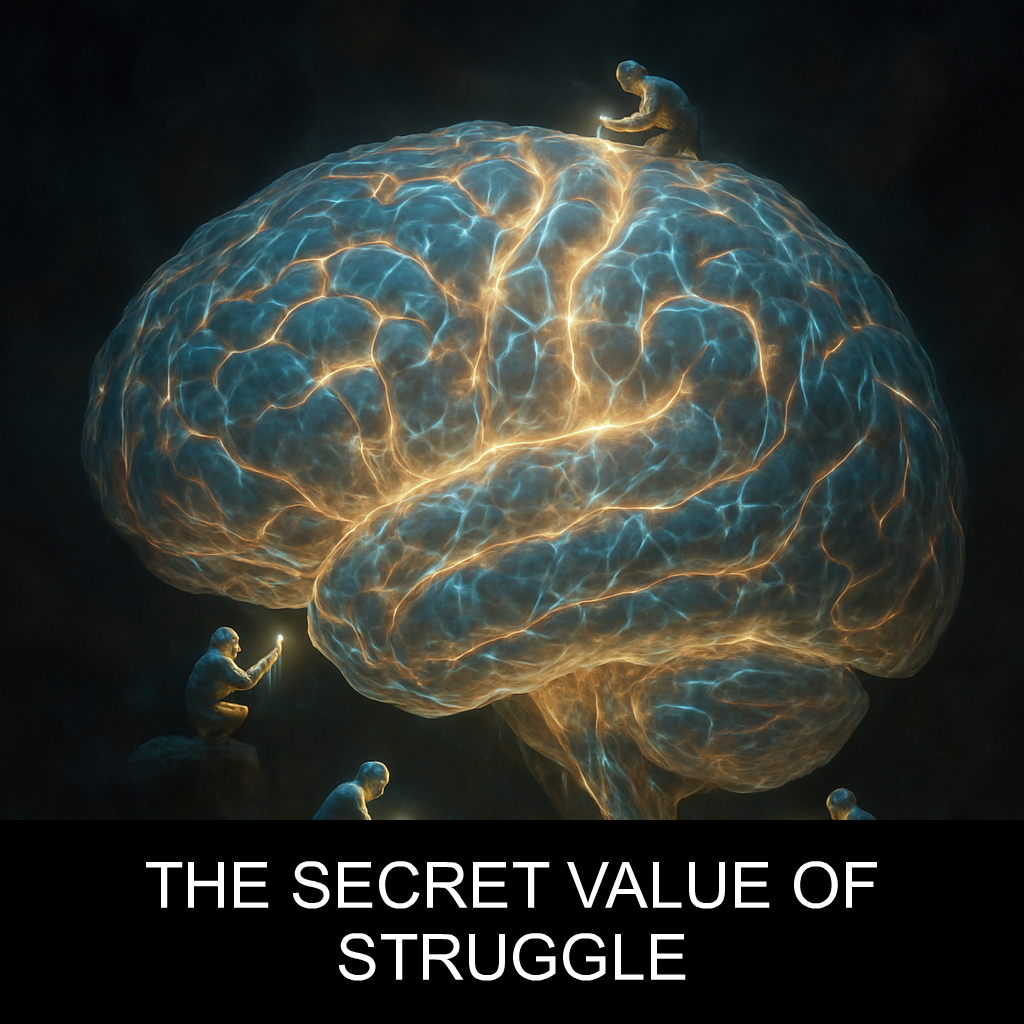

The Effort Amplification Principle: How Your Brain Secretly Makes You Love What You Suffer For
Ever finish building a piece of IKEA furniture, sweat beading on your forehead, Allen key scars on your fingers, and feel a ridiculous surge of pride? You look at that wobbly bookshelf, the one with the slightly misaligned door, and think, “It’s magnificent.”
But is it, really? Objectively, it’s just particle board and laminate. Yet, you love it more than the pre-assembled, professionally delivered version. Why? 🧐
This isn’t just about pride in your work. In my research into behavioral patterns, I’ve seen this phenomenon everywhere. It’s a powerful brain mechanism I call The Effort Amplification Principle. The rule is simple: the more effort you pour into something, the more your brain inflates its value.
It’s a beautiful, dangerous cognitive trick.
The Brain’s Crooked Accountant
Think of your brain as a tireless accountant trying to balance the books of your life. On one side, you have your actions (effort, time, pain). On the other, you have your beliefs and outcomes (value, reward, meaning).
When you spend eight agonizing hours assembling a MALM dresser, the ‘effort’ column on your mental ledger is massive. If your brain concludes the dresser is just a cheap piece of furniture, the books don’t balance. An internal alarm goes off. This is cognitive dissonance—the deeply uncomfortable feeling of holding two conflicting ideas.
“I am a smart, rational person.”
“I just wasted my entire Saturday on worthless junk.”
Something has to give. Since you can’t get the hours back, your brain’s accountant does the only thing it can. It changes the value in the ‘outcome’ column.
The thought process shifts. “I didn’t waste my time. I invested it. And because I invested so much, this dresser must be incredibly valuable. It has character. It represents my perseverance.”
Balance restored. Dissonance gone. You now love your wobbly dresser.
The Neurobiology Behind the Curtain
When studying the brain’s reward system, it becomes clear this isn’t just a psychological quirk. It’s hardwired. Behavioral studies I’ve analyzed show that the striatum, a key region in the brain’s reward circuit, is highly active not just when we receive a reward, but also when we anticipate and work for one.
The brain’s dopamine system isn’t just about pleasure; it’s about motivation. It’s the chemical that says, “This is worth pursuing! Keep going!” When we struggle, the brain has to justify the continued release of this motivational fuel. It does so by tagging the goal as increasingly important.
The effort itself becomes part of the reward signal. Your brain doesn’t just value the destination; it retroactively learns to value the difficult journey it took to get there. It reinforces the neural pathways associated with that struggle, making you more likely to defend the outcome.
Observed in Everyday Social Dynamics
This principle is a hidden engine running in the background of our lives.
It’s why fraternities and elite military units use brutal initiation rites. The intense shared struggle forges an unbreakable bond and makes membership feel like a sacred honor. No one endures hell week to join a club they believe is mediocre.
It’s why you defend your brutal, demanding career. You’ve invested too much to admit it might not be the perfect fit. So, you amplify its virtues and minimize its flaws.
It even explains why we sometimes stay in difficult relationships. The fight to make it work becomes ‘proof’ of the love’s depth. We’ve poured so much of ourselves into it, the thought of it being worthless is too painful. Our brain protects us by making us believe the struggle is heroic.
The Hidden Trap: When Effort Blinds You
The Effort Amplification Principle is a powerful tool for motivation. It can help you stick with a new skill, a fitness routine, or a creative project. Embrace the struggle, and your brain will reward you with a deeper sense of meaning.
But it has a dark side. It can be a trap. 🕳️
It’s the secret ingredient in the Sunk Cost Fallacy, where you keep pouring resources into a failing project because you’ve already invested so much. Your brain is amplifying the project’s potential value to justify the past effort, blinding you to the present reality. We overvalue what we’ve built, making us less objective and sometimes prone to errors in judgment, like assuming good character in those who support our hard-won project, a mistake similar to The Character Glimpse Fallacy.
How do you know if effort is helping or hurting you? Ask yourself these questions:
- If I were starting fresh today, with no prior investment, would I still choose this path/project/person?
- Am I defending the outcome based on its objective merits, or am I focused on how hard it was to achieve?
- What would an impartial outsider, who knows nothing of my struggle, say about this situation?
The answers can be brutally revealing.
Your brain is not your enemy, but it is a master storyteller. It will weave any narrative necessary to protect your sense of self and rational consistency.
So, the next time you feel that deep satisfaction after a grueling task, enjoy it. You’ve earned it. But also, take a moment to question it. Is this thing truly great, or did your brain just convince you it is because you paid for it in sweat?