
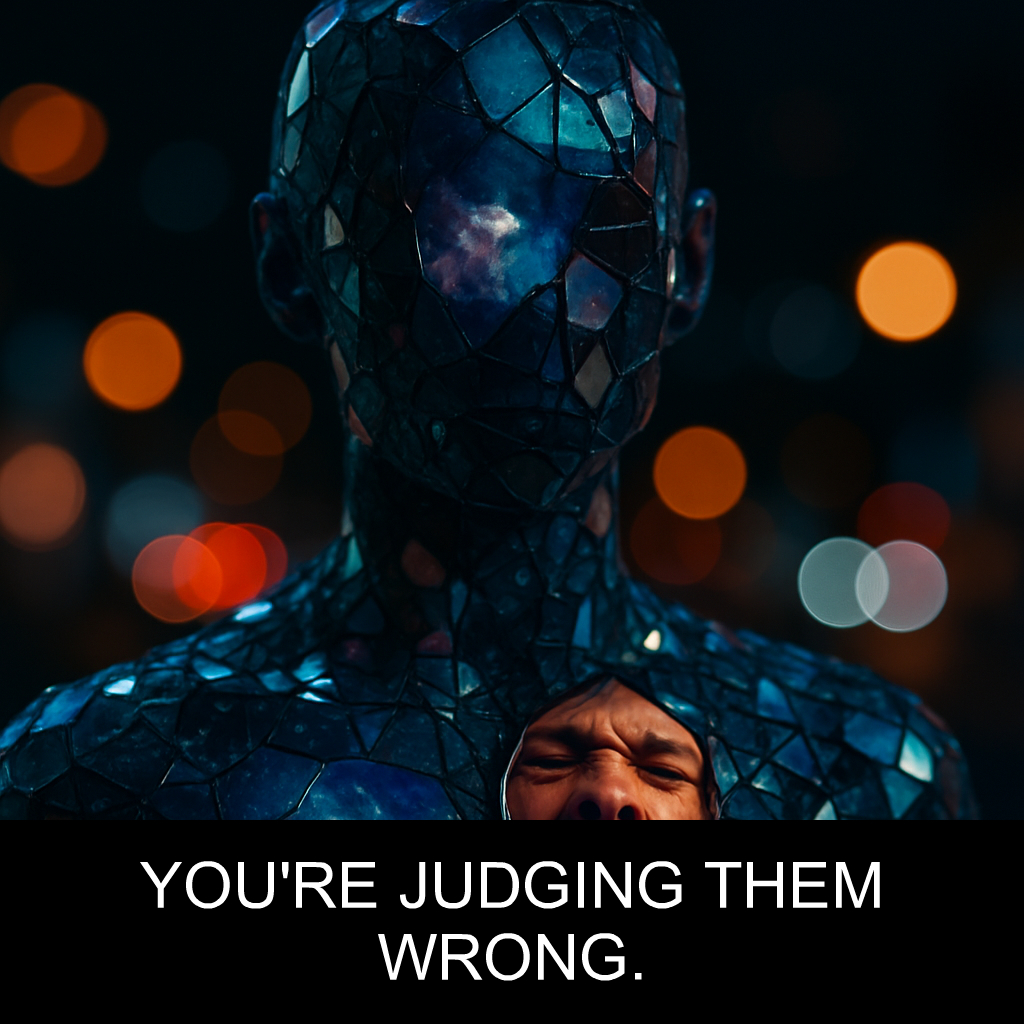

The Character Glimpse Fallacy: Why Your Brain Secretly Misjudges Everyone
Someone cuts you off in traffic. What’s the first word that pops into your head? 🤬
It’s probably not a charitable one. You think, “What a selfish jerk.” Your brain instantly writes a story, casts them as the villain, and files the case away. End of story.
But what if you were the one who just swerved? You’d have a reason. A very good reason. “I didn’t see them!” or “I’m rushing to the hospital!” or “I’m about to miss a flight!” Your story has context. Theirs doesn’t.
This, right here, is one of the most powerful and pervasive glitches in our mental software. In my research, I call it The Character Glimpse Fallacy. It’s the brain’s default setting to judge others by their actions, but ourselves by our intentions. And it runs our social lives without us even noticing.
The Hidden Blueprint: Actor vs. Observer
When studying behavioral patterns, I’ve found this bias is all about perspective. You are the *actor* in your own life. You have a full script—your thoughts, your feelings, your history, your stresses of the day. You know *why* you did what you did.
But when you see someone else, you are merely an *observer*. You don’t have their script. You only see one action, a tiny glimpse. Your brain, hating a vacuum, immediately fills in the blanks by attributing their action to their fundamental character. It’s a cognitive shortcut.
It’s like judging an entire movie based on a single, out-of-context frame. It’s efficient, but it’s almost always wrong.
A coworker misses a deadline. Your observer brain defaults to: “They’re lazy. Unreliable.”
You miss a deadline. Your actor brain explains: “The project scope changed, I had three other urgent things come up, and I barely slept last night.”
See the double standard? It’s a protection mechanism for our own ego and a massive barrier to understanding others.
Why Your Brain Loves This Lie
This isn’t a personal flaw. It’s a feature of the human brain designed for survival. Thousands of years ago, quickly judging a stranger’s intent (friend or foe?) was critical. Assuming the worst based on a single action was safer than waiting for context.
Today, that ancient software is still running on our modern hardware. It creates a world of villains instead of a world of people having a bad day. It fuels gossip, ruins relationships, and destroys teamwork.
Observed in everyday social dynamics, this is also a primary driver behind what’s known as The Focusing Illusion, where we place far too much importance on the one thing we can see—the action—while completely ignoring the vast, invisible context surrounding it.
The Self-Serving Flip Side
The fallacy gets worse. When things go well for us, we flip the script. We attribute our successes to our internal character. “I got the promotion because I’m a hard worker.”
But when others succeed? “Oh, they just got lucky.” Or, “They knew the right people.”
This self-serving bias is the Character Glimpse Fallacy’s twin. Together, they create a distorted reality where we are the complex, well-intentioned heroes in a world of one-dimensional, poorly motivated NPCs. It’s a lonely way to live. Some people are acutely aware of this bias and may even use stressful situations to make others look bad, then try a The Forced Teaming Tactic to get you on their side against the perceived ‘jerk’.
How to Override the Faulty Code
You can’t stop the initial thought. It’s an automatic reflex. But you don’t have to believe it. According to behavioral studies I’ve analyzed, the key is to create a conscious pause between the event and your judgment. Here’s how. 🧠
- Ask the Context Question: The moment you feel the judgment rising, stop. Ask yourself one simple question: “What unseen story could make this action understandable?” You don’t have to know the answer. Just asking the question shifts your brain out of its lazy default.
- Generate Three Alternatives: Force yourself to invent three plausible, situational reasons for the other person’s behavior. The driver who cut you off? 1) Their kid is sick in the back seat. 2) They are a tourist and confused by the roads. 3) They just got terrible news and are distracted by grief. This exercise rewires your brain to see possibilities, not just personalities.
- Separate the Action from the Person: Instead of thinking “He IS a jerk,” reframe it as “That WAS a jerky move.” This tiny change in language is profound. It judges the specific action, not the person’s entire being, leaving room for a different action next time.
This isn’t about making excuses for bad behavior. It’s about reserving judgment until you have more than a single, blurry frame. It’s about trading the satisfaction of being right for the possibility of being compassionate.
So, who in your life have you written off based on a single glimpse?