
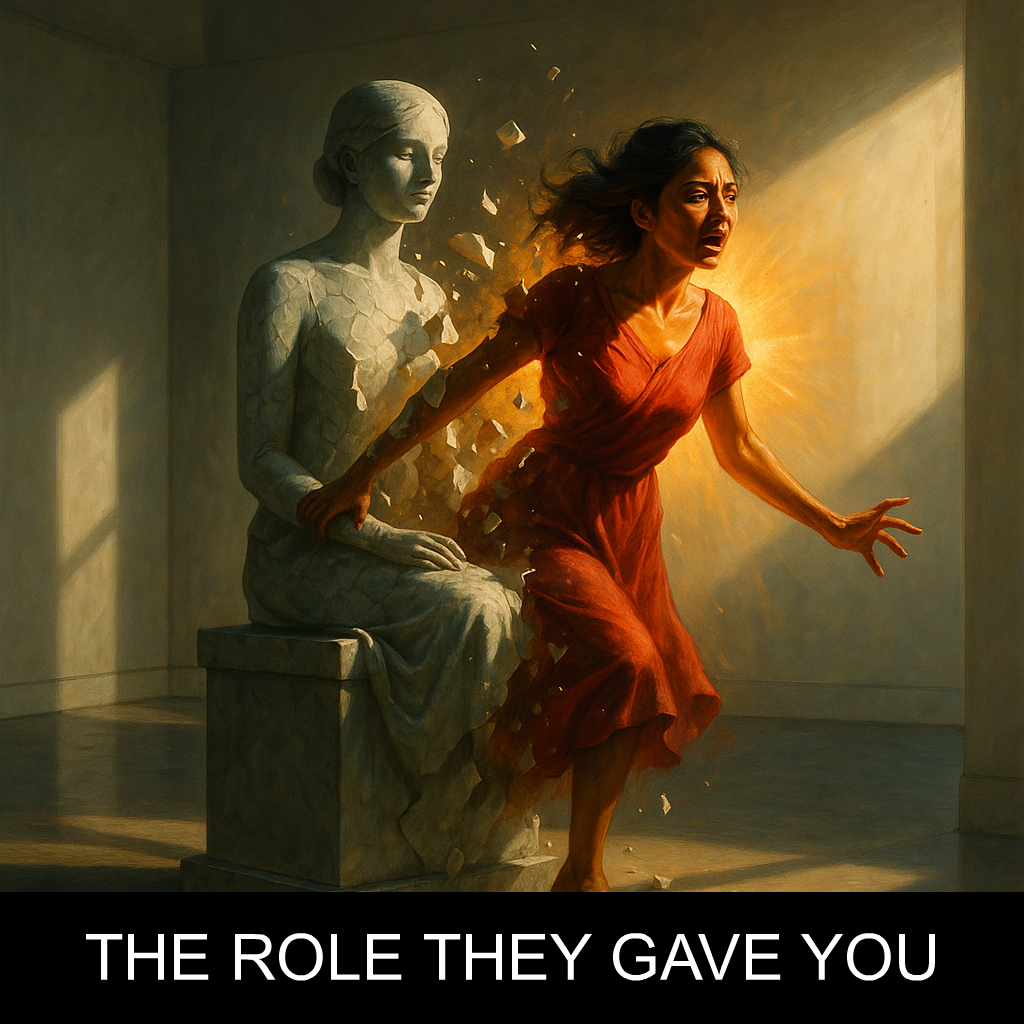

The Narrative Anchor Syndrome: The Invisible Role You Can’t Escape
The Unseen Script
Ever feel like you’re stuck playing a character in your own life? The ‘funny one’ who can’t be taken seriously? The ‘reliable one’ who can’t ever say no? The ‘wild card’ who isn’t trusted with responsibility?
It’s not just in your head. When studying behavioral patterns in groups, I’ve observed a powerful, unspoken force at play. It’s a phenomenon I call The Narrative Anchor Syndrome.
It’s the process where a group—be it your family, friends, or coworkers—unconsciously assigns you a fixed story. A role. And once that anchor is dropped, it takes a Herculean effort to pull it up. Every action you take is then filtered through the lens of that pre-written narrative.
Why Your Brain Loves Labels
This isn’t malicious, not usually. It’s about cognitive efficiency. Our brains are lazy. They crave shortcuts to save energy. It’s far easier to keep someone in a neat, predictable box than it is to constantly re-evaluate their evolving personality. 🧠
Once you’re labeled ‘the disorganized creative’, your brain, and the brains of those around you, will actively seek evidence to confirm this. It’s a cognitive bias in action. An organized report you submit? A fluke. A messy desk? Ah, see! Classic you.
This is tied to what I’ve researched as The Social Gravity Law, where the collective expectation of the group pulls you back into your designated orbit, making deviation feel almost impossible.
The Anchor in Action: Everyday Scenarios
Once you see it, you can’t unsee it. Observed in everyday social dynamics, the anchor shows up everywhere.
In the Family: You might be the ‘rebel’. You could be a 40-year-old accountant with a perfect credit score, but at Thanksgiving, your parents still tell stories about you sneaking out as a teen. Your responsible adult self is invisible. It doesn’t fit the narrative.
At the Office: You were hired as a junior assistant. Years later, you’ve gained immense skill and expertise. Yet, senior colleagues still treat you like the new kid, overlooking you for major projects. Your narrative is ‘the intern’, and the anchor is deep.
In Your Friend Group: You’re the ‘therapist friend’. You’ve spent years listening and giving advice. The one time you have a crisis and need support, your friends seem awkward, even dismissive. Your attempt to be vulnerable violates the script. You’re not supposed to have problems; you’re supposed to solve them.
The Hidden Danger: A Cage Made of Comfort
This syndrome does more than just annoy you. It actively suffocates your potential. It tells you who you are, who you can be, and who you *can’t* be.
You stop trying to be assertive because you’re the ‘easy-going one’.
You stop sharing creative ideas because you’re the ‘analytical one’.
The narrative anchor becomes a self-fulfilling prophecy. You start to believe the story yourself. You begin to perform the role without even thinking. It’s the path of least resistance. And it is a trap.
Pulling Up The Anchor: How to Re-Write Your Story
Escaping this isn’t easy. It requires deliberate, sustained effort. According to behavioral studies I’ve analyzed, breaking social patterns requires consistent disruption. You have to make it more work for them to keep you in the box than to accept your new reality.
- Pattern Interrupt Deliberately: If you’re the ‘quiet one’, make it a point to speak first and with conviction in the next three group settings. If you’re the ‘funny one’, actively choose to share a serious, thoughtful insight. The actions have to be undeniable.
- Re-Frame Verbally: When someone assigns you the old role, gently correct it. “You always know how to fix these things!” can be met with, “I’m happy to help, but I’m actually trying to step back from being the default problem-solver.” It feels confrontational. It’s necessary.
- Change Your Environment: This is the hard truth. Sometimes, the anchor is too heavy. The narrative is too entrenched. The only way to write a new story is to find a new audience. Joining a new club, team, or even changing jobs can be liberating, as you enter as a blank slate.
The story others tell about you is powerful. But the story you believe about yourself is the only one you have to live with.
So, are you the author, or just a character playing a part?