
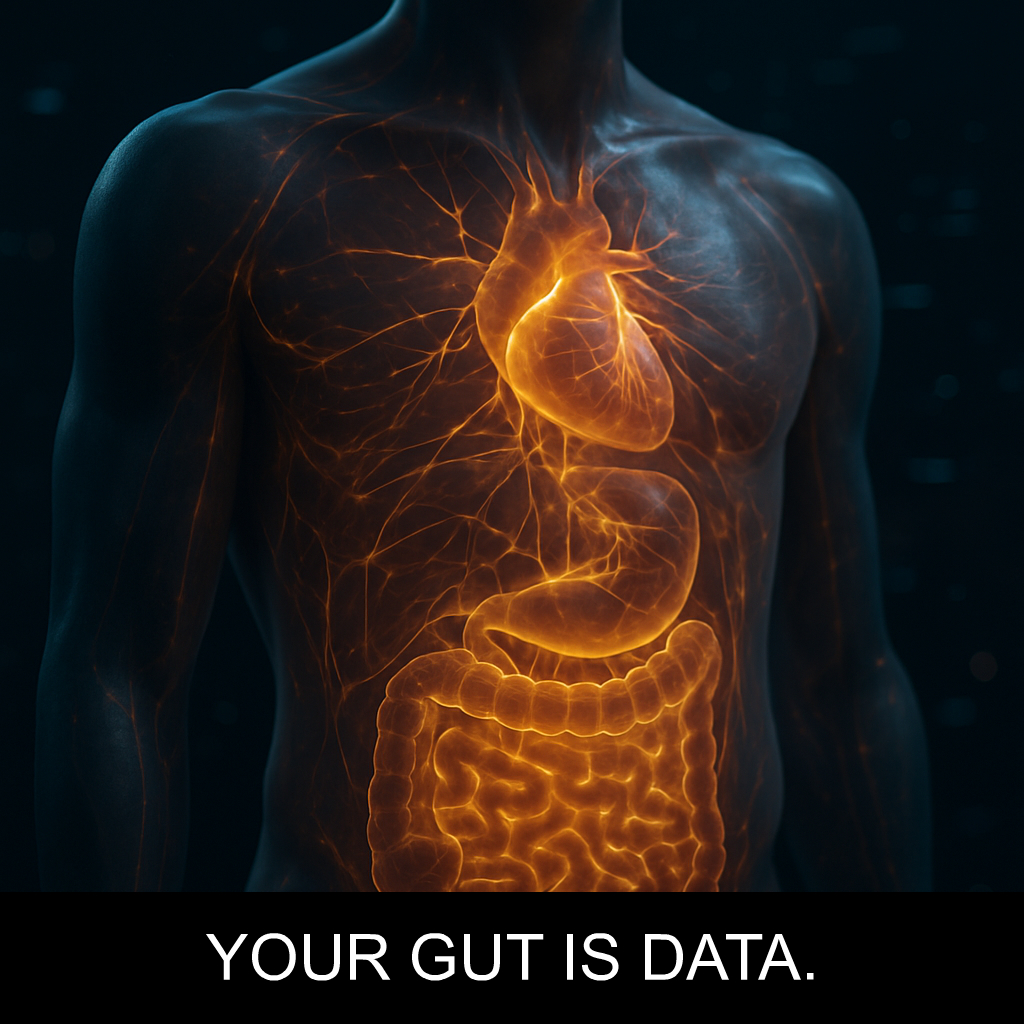

The Somatic Feedback Loop: Why Your Gut Is a Biological Supercomputer
Have you ever walked into a room and felt an immediate, icy chill down your spine? Not because the AC was on, but because something about the vibe felt wrong? You couldn’t name it. You hadn’t even spoken to anyone yet. But your body was screaming at you to leave. In my research into the hidden mechanics of the mind, I’ve found that this isn’t some mystical “sixth sense.” It’s actually a sophisticated biological accounting system known as the Somatic Feedback Loop.
When studying behavioral patterns, I became obsessed with how we make split-second decisions. Most people think we weigh pros and cons like a spreadsheet. We don’t. Our brains are far too messy for that. Instead, we use our bodies as a shortcut. Every experience you’ve ever had—every failure, every win, every awkward date—has been tagged with a physical sensation. This is the core of the Somatic Marker Hypothesis, popularized by neuroscientist Antonio Damasio. It’s the brain’s way of highlighting the important parts of your history so you don’t have to relearn them every single day.
The Biological Highlighter
Think of your brain as an overworked librarian in a massive archive. This librarian doesn’t have time to read every book when you ask a question. Instead, they look for the books with the bright yellow highlighter on the pages. Those highlights are your somatic markers. When you face a situation, your ventromedial prefrontal cortex (VMPC) quickly scans your past. It triggers a physical reaction—a “somatic state”—that mimics how you felt in similar past scenarios.
Your heart rate climbs. Your stomach tightens. Your palms get slightly damp. This is your body giving you the “answer” before your conscious mind even understands the question. It’s why you might feel a sudden rush of anxiety when a specific manager emails you, even if the text is neutral. Your body remembers The Cortisol Spike Paradox from your last interaction, and it’s warning you before you even finish reading the subject line.
It’s fast. It’s brutal. And it’s almost always right.
The Iowa Gambling Task: Evidence in the Blood
One of the most fascinating cognitive experiments I’ve analyzed involves the Iowa Gambling Task. Participants were asked to pick cards from four decks. Two decks offered high rewards but even higher, devastating losses (the “bad” decks). The other two offered smaller rewards but very low losses (the “good” decks).
The results were staggering. Long before the participants could logically explain which decks were dangerous, their bodies already knew. When their hands reached for the “bad” decks, their skin conductance response (a measure of sweat and stress) spiked. Their bodies were generating a warning signal before their brains had formulated the thought, “This deck is a trap.” They were literally feeling the risk.
This reveals a profound truth: Your body is a data-processing machine that operates at speeds your conscious logic can’t touch. When you ignore your gut, you aren’t being “rational.” You are actually ignoring the most comprehensive database of your own life experiences.
The Neurochemical Dance
This loop doesn’t just warn us of danger; it also guides us toward rewards. When you are on the verge of a breakthrough or a positive social connection, your body releases subtle pulses of neurochemicals that feel like “excitement” or “flow.” This is often linked to The Dopamine Baseline Paradox, where the body anticipates a reward and adjusts your internal state to prepare for it.
However, the loop can be hijacked. If you’ve spent years in a toxic environment, your somatic markers might be calibrated to fear things that are actually healthy. A quiet, stable relationship might feel “boring” or even “wrong” because your body is addicted to the high-stress markers of past chaos. Re-calibrating these markers is the work of a lifetime, but it starts with simply noticing the physical sensations.
How to Use Your Biological Supercomputer
If you want to tap into this power, you have to stop living entirely in your head. Start practicing what I call the “Physical Audit” during your day. When a new opportunity or person enters your orbit, don’t ask “Does this make sense?” Ask “What is my body doing right now?”
- Check your breath: Is it shallow and high in your chest, or deep and relaxed?
- Scan your tension: Are your shoulders creeping toward your ears? Is your jaw clenched?
- Monitor your gut: Do you feel a literal “sinking” feeling, or a sense of expansion?
- The 3-Second Rule: Before responding to a high-stakes request, wait 3 seconds and just feel the physical echo in your chest.
These aren’t just feelings. They are the compressed data of your entire existence trying to communicate with you. Your logic is a filter; your body is the source. The next time you feel that “bad vibe,” don’t dismiss it as paranoia. Your biological computer just finished a million simulations and found a threat.
Are you going to listen, or are you going to wait for the disaster to prove your body right?