
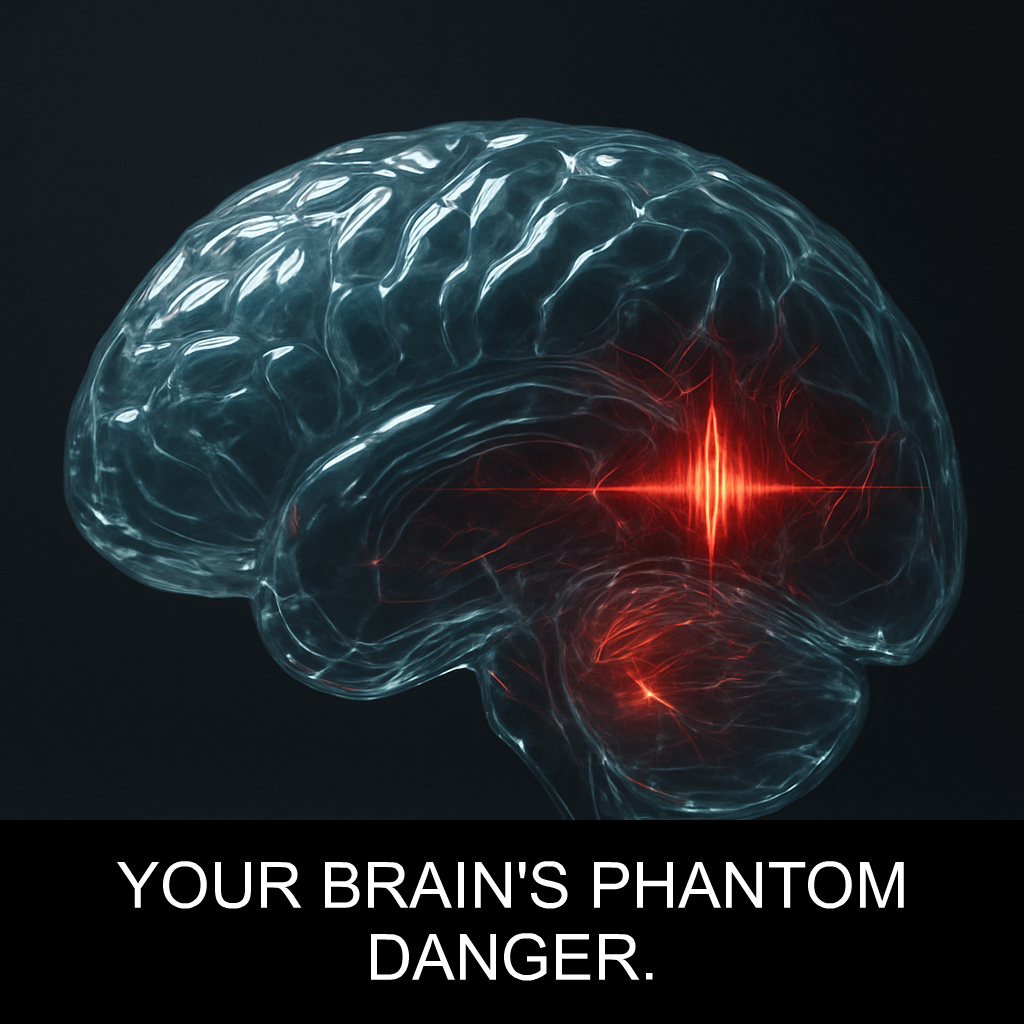

The Neural Threat Echo: Why Your Brain Still Reacts to Dangers That Are Long Gone
Ever notice it? That weird, phantom reaction. A certain tone of voice in an email makes your stomach clench, reminding you of a toxic boss from five years ago. You drive past an intersection and your hands grip the wheel, a ghost memory of a minor fender-bender that happened a decade back. You’re safe. You’re fine. But your body doesn’t believe you. 🧠
This isn’t just you being “overly sensitive.” In my research into human behavior, I’ve become obsessed with this phenomenon. I call it the Neural Threat Echo.
It’s the lasting neurological footprint of a threat that is long gone, still ricocheting through your nervous system and influencing your decisions today.
So, What Exactly Is the Neural Threat Echo?
Think of your brain’s amygdala as a highly sensitive smoke detector. Its only job is to scream “FIRE!” at the first sign of trouble to keep you alive. It’s a primal, ancient system designed for a world of immediate, physical threats. Saber-toothed tigers. Rival tribes. Sudden danger.
It works brilliantly. Too brilliantly, sometimes.
When you experience an intensely stressful event—a brutal layoff, a painful betrayal, a public humiliation—that smoke detector doesn’t just go off. The event is so powerful that it essentially breaks the sensitivity dial. It gets stuck on high alert.
The original “fire” is out, but the detector now shrieks at a puff of steam from the kettle. That’s the echo. It’s a physiological memory that keeps your body braced for an impact that will never come again.
The Science I’ve Analyzed: From Saber-Toothed Tigers to Slack Notifications
From a neurobiological standpoint, what’s happening is fascinating. That past event flooded your system with cortisol and adrenaline. According to behavioral studies I’ve analyzed, the brain creates a powerful association—a neural shortcut. It links the sensory data of the event (the place, the person’s face, the words used) directly to a full-blown survival response.
The problem is, our modern “tigers” are often psychological. A condescending manager. A passive-aggressive email. Social rejection. These don’t threaten our lives, but they trigger the same ancient hardware. When these threats are chronic, like in a toxic work environment, the Neural Threat Echo becomes deafening.
Observed in everyday social dynamics, this is also amplified by concepts like The Implicit Role Casting Effect, where someone repeatedly treats you as incompetent, casting you in a role that your brain logs as a persistent social threat. Years later, anyone who vaguely resembles that person or situation can trigger the echo, and your brain prepares for a battle that only exists in its memory.
The Everyday Glitches Caused by the Echo
This isn’t some abstract concept. It has real, tangible costs. The echo is like a background app draining your phone’s battery. It depletes your cognitive and emotional resources. 😩
When studying behavioral patterns, I see the echo manifest in a few key ways:
- Decision Paralysis: You avoid opportunities that remotely resemble a past failure. You won’t apply for a promotion because the interview process reminds you of a previous rejection.
- Emotional Overreactions: A colleague offers mild, constructive feedback, but your brain hears the roaring voice of a hypercritical parent, and you either shut down or lash out.
- Chronic Procrastination: You delay starting a project because the initial phase of uncertainty triggers the echo of a past project that went horribly wrong.
- Inability to Relax: You’re physically safe at home, but your nervous system is still scanning the horizon for predators. You can’t just *be*.
How to Silence the Echo: A Researcher’s Toolkit
You can’t just tell your brain to stop. That part of your brain doesn’t understand language; it understands safety signals. Logic is useless here. Action is everything.
Here’s a practical toolkit I’ve pieced together from various cognitive and somatic disciplines:
- Name the Echo. The next time you feel that familiar dread, that tension in your chest, pause. Don’t fight it. Acknowledge it. Say to yourself, “Ah, there it is. The Neural Threat Echo from that job in 2018. My brain is trying to protect me.” Simply naming it separates you from the raw emotion. It gives you a sliver of control.
- Send a Somatic “All-Clear” Signal. Your body needs proof that the threat is over. The fastest way is through the nervous system. Try this: 5 seconds of vigorously shaking your hands and legs. It seems silly, but it mimics the animal instinct of literally “shaking off” stress. Follow it with three deep, slow exhales. This tells your vagus nerve, the superhighway of your relaxation response, that the danger has passed.
- Create a Counter-Narrative. The echo survives on an old, unfinished story where you were a victim. You need to write a new ending. Actively recall the threatening memory, but this time, focus on how you survived it. What did you learn? How are you stronger now? Verbally state, “That situation was temporary. It ended. I am here now, and I am safe.”
Your brain is a pattern-matching machine, not a truth machine. It’s running old software on new hardware. It’s up to you to install the update.
Are you going to let a ghost from your past steer your future?