
The Narrative Gravity Effect: The Hidden Story Your Brain Tells You Is True
Ever notice how a single mistake can define someone in your mind? One bad presentation, and a colleague becomes “the incompetent one.” One forgotten anniversary, and a partner is labeled “thoughtless.”
It’s not because you’re judgmental. It’s because your brain is a relentless storyteller. And it has a favorite plot.
In my research into cognitive shortcuts, I’ve become obsessed with a powerful, hidden force I call The Narrative Gravity Effect. It’s the brain’s subconscious tendency to pull disparate pieces of information into a single, coherent story. Like gravity, it’s an invisible force that bends reality around a central, heavy idea. Once that story is formed, it’s incredibly difficult to escape its pull. 😮
What Is The Narrative Gravity Effect?
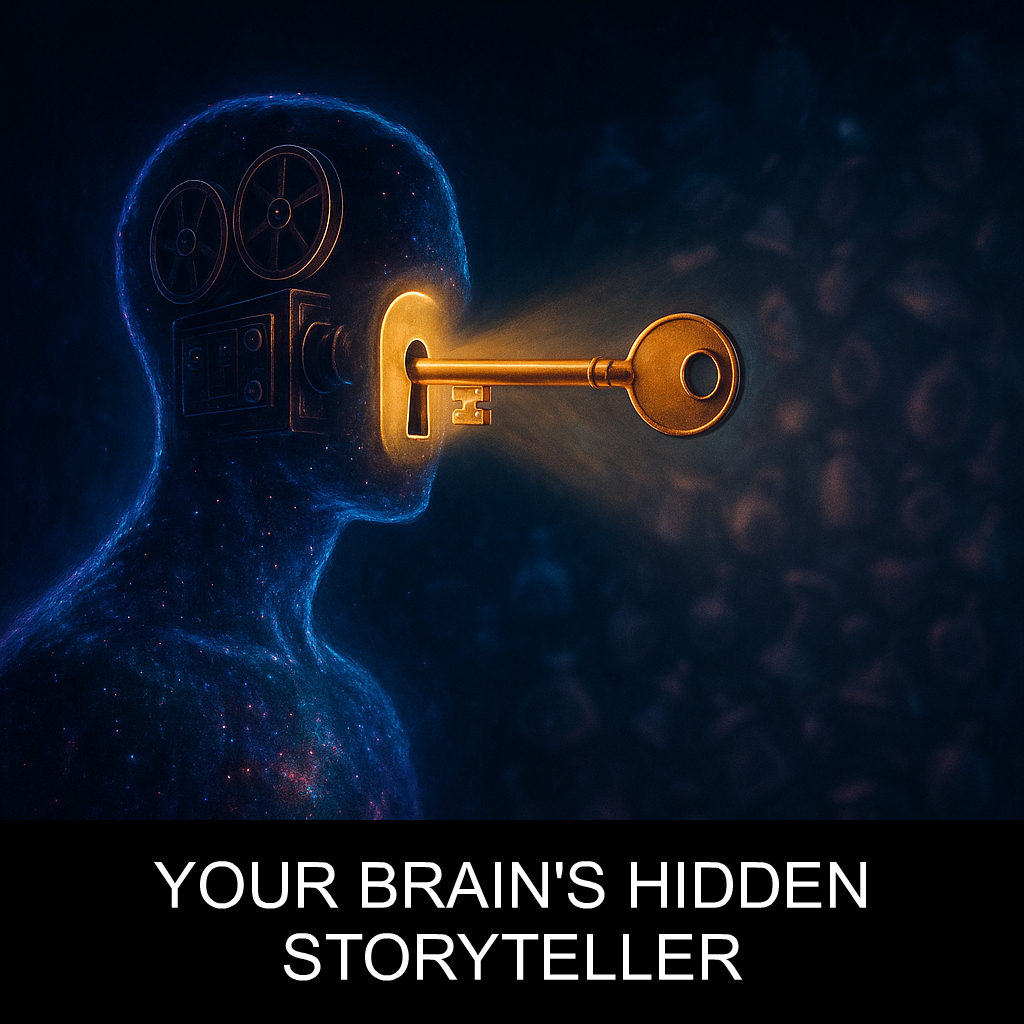
Think of your brain as a movie director on a tight budget and an even tighter deadline. It receives thousands of clips (perceptions, facts, interactions) every single day. To create a coherent film, it can’t use everything. It has to choose.
So, it creates a simple script. “Jim is lazy.” “This project is doomed.” “I’m bad at public speaking.”
From that moment on, the director—your brain—selects only the clips that fit the script. Jim shows up two minutes late? Perfect, that makes the final cut. He stays an hour late to help a coworker? That clip ends up on the cutting room floor. It complicates the plot.
This isn’t about logic. It’s about energy conservation. Crafting a simple, linear story is metabolically cheap. Grappling with nuance, contradiction, and complexity is expensive. So your brain takes the easy way out.
It saves energy. But it costs you the truth.
The Brain Science Behind the Story
When studying behavioral patterns, it’s clear this isn’t a new phenomenon. The Narrative Gravity Effect is a close cousin to confirmation bias, but it’s more about structure than simple agreement. It’s not just seeking facts that confirm a belief; it’s about actively rejecting facts that would make the *story* less elegant.
Cognitive dissonance plays a huge role here. Holding two contradictory ideas is uncomfortable. For instance: “My partner is a loving person” and “My partner did a deeply selfish thing.” The brain scrambles to resolve this tension. The easiest way? Discard one of the ideas. The Narrative Gravity Effect determines which one gets tossed based on which story is already “heavier” or more established in your mind.
It’s an internal mechanism of self-deception, which makes it far more subtle than external social pressures. It’s not about someone trying to manipulate you, like with The Favor-Induced Liking Principle, where actions are designed to make you like someone. This is your own mind curating reality for you, without your permission.
Where Narrative Gravity Pulls You In Everyday Life
Observed in everyday social dynamics, this effect is everywhere. Once you see it, you can’t unsee it.
At Work: A manager forms a narrative that an employee is a “rising star.” That employee’s successes are amplified and seen as proof of genius, while their failures are excused as “a valuable learning experience.” Meanwhile, the employee with the “slacker” narrative has their successes minimized as “flukes” and their failures magnified as proof of their incompetence.
In Relationships: You’ve built a story that your friend is “unreliable.” You’ll remember the one time they canceled plans but forget the five times they showed up for you without question. The narrative of unreliability has more gravity; it pulls the confirming evidence into its orbit and repels everything else. 💔
In Your Self-Perception: This is the most dangerous arena. If you’ve told yourself the story “I’m not creative,” you will interpret every struggle as proof. You’ll ignore your moments of unique insight. This is how we build our own psychological prisons. We write the script, direct the movie, and then convince ourselves we’re just watching a documentary of our lives.
How to Escape the Pull: A Practical Checklist
You can’t stop your brain from telling stories. But you can become a better editor. You can challenge the director. Here’s how to start:
- Become the “Data Detective”: Don’t just consume the story your brain offers. Actively hunt for contradictory data. Ask one simple question: “What evidence would I need to see to know this story is wrong?” Then, go look for it.
- Embrace the “Plot Twist”: When a contradictory fact appears, don’t explain it away. Treat it as a plot twist. See it as a sign that your initial story was too simple. True intelligence isn’t about being right; it’s about being willing to become less wrong.
- Tell Three Stories: For any significant event or judgment, force yourself to write three different possible narratives. The first is your gut reaction. The second is the opposite. The third is a wild, outside-the-box interpretation. This single exercise shatters the monopoly of the first story and introduces cognitive flexibility.
- Use a “Judgment Pause”: The Narrative Gravity Effect works fastest when you’re on autopilot. Before solidifying a judgment about a person or situation, insert a deliberate pause. A breath. A walk. A night’s sleep. The first story is usually the laziest one. Give a better one time to emerge.
The stories we believe become the reality we inhabit. They dictate who we trust, what risks we take, and who we believe we are.
The most important question isn’t “Is my story true?” but “Is this the *only* story?” What is your brain not letting you see?