
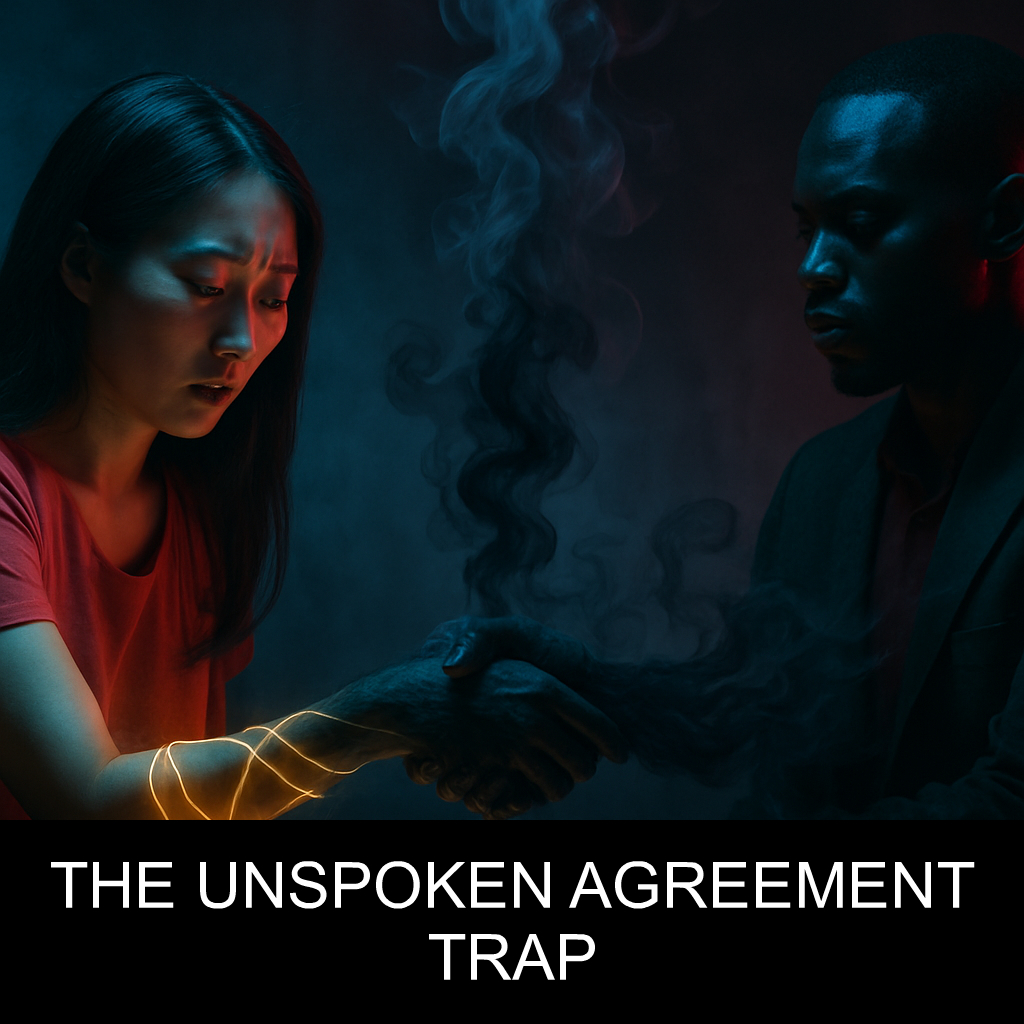

The Implicit Contract Fallacy: The Hidden Agreements Controlling Your Life
The Unspoken Debt
Think about that one person. The friend who asks for a ride to the airport at 5 AM. The coworker who needs you to cover their shift, again. The family member who needs to borrow money, just until next week. When you hesitate, a strange feeling creeps in. Guilt.
It’s a feeling of obligation, as if you *owe* them this. But why? You never signed anything. You never gave your word. Yet, the sense of debt is real, and it’s heavy.
In my research into manipulative social dynamics, I’ve seen this pattern emerge constantly. It’s not an accident. It’s a highly effective, often unconscious, strategy I call The Implicit Contract Fallacy. It’s the hidden agreement you never consented to, but are expected to honor.
What is This Secret Contract?
The Implicit Contract Fallacy is the belief that an unspoken, un-negotiated agreement exists between two people, where the terms are defined entirely by one party for their own benefit.
It’s a psychological trap. One person—the architect of the contract—establishes a pattern of behavior that implies a set of rules. The other person—the target—complies, assuming it’s a fair, reciprocal arrangement built on goodwill. But it never is.
It’s like signing a contract written in invisible ink. You feel its weight, you adhere to its obligations, but you can’t actually read the terms. And the other person can change them whenever they want. They hold all the power.
How It’s Forged in Silence 🤫
Observed in everyday social dynamics, this fallacy isn’t created with a single grand gesture. It’s built slowly, piece by piece, in the quiet spaces between conversations.
First comes the **”Goodwill Investment.”** The manipulator performs a series of small, unsolicited favors. They buy you coffee, offer you a ride, or give you a compliment. These aren’t acts of kindness. They are deposits into a psychological bank account. They are creating leverage.
Next is the **Pattern of Expectation.** A precedent is set. They might always help you with small tasks at work. This trains you to see them as “the helpful one.” You unconsciously accept this dynamic. You are being conditioned.
Finally, there’s the **Call-In.** The moment they cash in. They make a huge, disproportionate request that far outweighs their initial “investments.” They need you to lie to their boss, co-sign a loan, or dedicate your entire weekend to their project. When you flinch, the trap springs. They don’t need to say, “After all I’ve done for you.” You say it to yourself. The guilt is the enforcement mechanism.
The Psychological Hooks That Keep You Trapped
Why is this so effective? According to behavioral studies I’ve analyzed, it preys on some of our most fundamental human instincts.
The Guilt Engine: Humans are wired for reciprocity. The feeling of being indebted is deeply uncomfortable. Manipulators exploit this by creating a manufactured debt, putting you in a state of perpetual obligation.
The Aversion to Conflict: Calling out an implicit contract means starting a confrontation. You have to say, “Hey, it feels like you’re implying I owe you, and that’s not fair.” It’s awkward. It’s tense. Most people would rather perform the unreasonable task than have that conversation. It’s just easier.
Cognitive Dissonance: We need our actions and beliefs to align. If we’ve been complying with this unspoken contract for months, our brain needs to believe it’s a fair arrangement. Admitting it’s a sham means admitting we’ve been naive or exploited. This cognitive discomfort is so strong that we often fall deeper into the trap, a pattern closely related to The Justification Treadmill Bias, where we endlessly rationalize our own entrapment.
Recognizing the Red Flags in Your Life
This fallacy may be controlling one of your relationships right now. Look for the signs:
- You feel a constant, low-grade sense of obligation to someone, but you can’t pinpoint why.
- The balance of favors feels consistently off. You give 90%, they give 10%.
- You feel intense guilt for saying “no” to them, even for a perfectly reasonable reason.
- When you try to set a boundary, they act wounded or accuse you of being selfish or ungrateful.
- The relationship feels more like a series of transactions than a genuine connection.
How to Tear Up the Invisible Contract
Escaping this trap doesn’t require a dramatic showdown. It requires precision and a quiet refusal to play the game. You have to make the implicit explicit.
This is the kill switch. When the manipulator makes their big request, verbalize the hidden contract. Say it out loud. For example: “It seems like you think that because you gave me your old couch, I should invest $5,000 in your new business idea. Is that how you see it?”
Silence. The absurdity of the contract withers when exposed to direct light. They will likely backtrack, deny it, or become flustered. The spell is broken.
You can also use a “Pattern Interrupt” statement. Instead of yes or no, simply say, “I’ll have to get back to you on that.” This buys you time, breaks their script, and re-establishes your control over your own decisions.
These contracts only have power because they live in the dark. Drag them into the light and watch them turn to dust. Who in your life holds an invisible contract over you?