

The Social Gravity Law: The Hidden Force That Shapes Your Every Decision in a Group
Picture this. You’re in a meeting. A terrible, monumentally bad idea is proposed. You can feel it in your gut. This plan is a lead balloon, destined to crash and burn. You open your mouth to object, but you pause. You scan the room. 😶
Silence.
Ten, fifteen, twenty other faces are looking at the speaker, then at each other. No one frowns. No one shakes their head. There’s just… quiet acceptance. And in that moment, a powerful, invisible force takes hold of you. Your objection dies in your throat. You start to second-guess your own gut feeling. Maybe I’m the crazy one. Maybe I’m missing something. You nod along with everyone else.
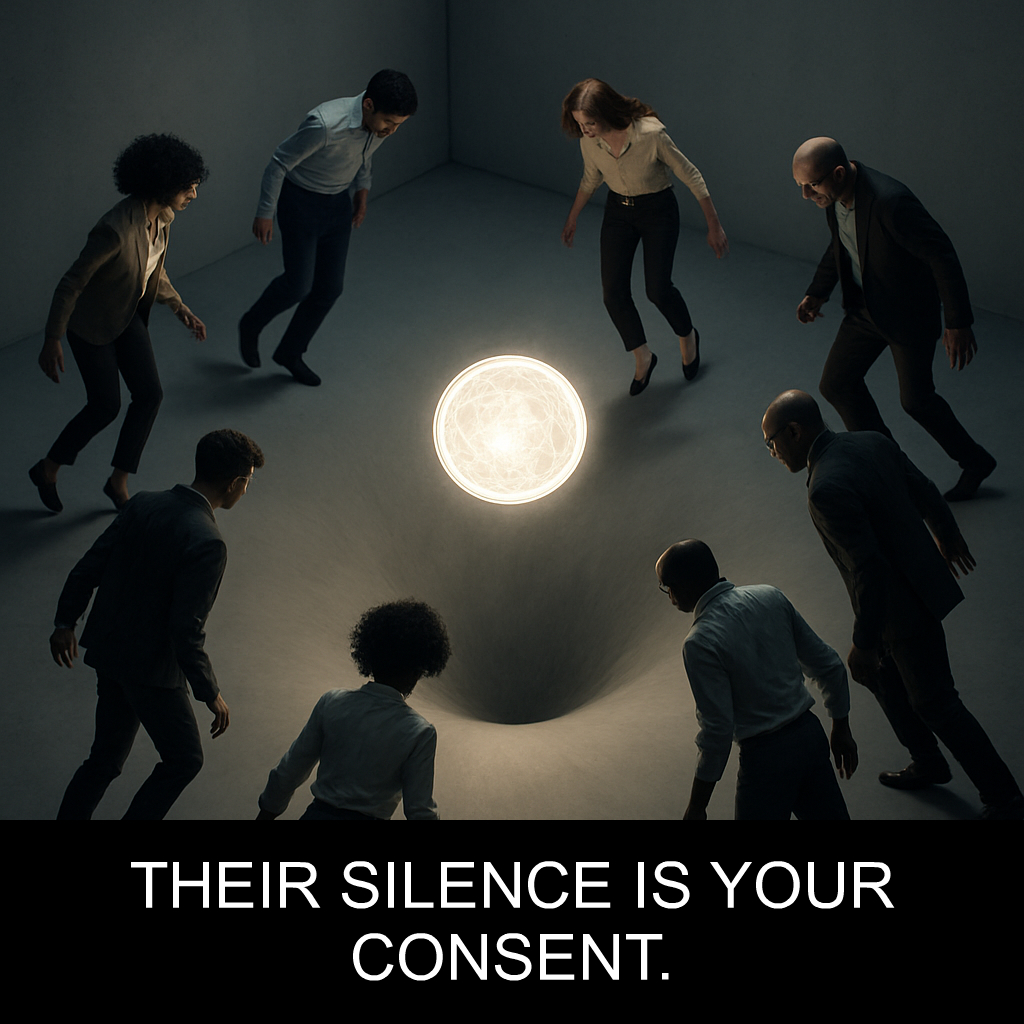
In my research into group behavior, I’ve seen this pattern repeat with terrifying consistency. It’s a phenomenon I call The Social Gravity Law. It’s the invisible pull that a perceived group consensus exerts on an individual, forcing them into an orbit of conformity, even when no explicit pressure is applied. It’s the assumption of agreement that becomes more powerful than actual agreement.
What Is This Invisible Pull?
Think of a planet. The more massive it is, the stronger its gravitational field, pulling smaller objects into its orbit. The Social Gravity Law works the same way. The perceived “mass” of a group’s opinion creates a social pull.
The terrifying part? The mass doesn’t even have to be real.
It’s manufactured from silence. When people fail to voice dissent, their silence isn’t registered as neutral; it’s registered as tacit approval. Each silent person adds to the perceived mass of the consensus. Your brain, a social survival machine, observes this and calculates its trajectory. It concludes that moving against this massive object is dangerous and metabolically expensive. It’s safer to just fall into orbit.
This is why a confident leader can propose something absurd, and if the first few key people stay silent, the entire room will likely fall in line. Their silence creates the initial gravitational field.
How Social Gravity Warps Your Reality
Observed in everyday social dynamics, this law is the engine behind a fascinating cognitive glitch known as “pluralistic ignorance.” This is where a majority of group members privately reject a norm, but they go along with it because they incorrectly assume that most others accept it. Everyone is conforming to a standard that nobody actually believes in.
It’s the friend group that keeps going to the same boring bar every Friday because everyone thinks everyone else loves it. In reality, they all secretly wish they were doing something else.
It’s the corporate team that continues a failing project because no one wants to be the one to admit it’s a waste of time. The project has achieved its own social gravity. To challenge it feels like challenging the group itself.
This happens because we become actors following an unwritten script. We fall back on what seems socially safest, which is often mimicry. This is deeply connected to what I’ve analyzed as The Behavioral Scripting Principle, where we default to pre-programmed social behaviors to avoid the friction of dissent. Silence is the script for “go along to get along.”
The Brain’s Role: Why We Bend to Unspoken Rules
According to behavioral studies I’ve analyzed, our brains are hardwired to react to social exclusion as a genuine threat to our survival. Neuroscientists have found that the anterior cingulate cortex, the part of the brain that fires up when we feel physical pain, also activates when we experience social rejection or the threat of it.
Breaking from the silent consensus is a gamble. It’s a social risk. Your primitive brain screams: “Don’t do it! You’ll be cast out! You’ll be alone!” This fear is often far more potent than the logical part of your brain telling you the idea on the table is flawed.
You aren’t just worried about being wrong; you’re terrified of being alone. This also explains our tendency to overestimate how much people are noticing our actions, a phenomenon known as The Spotlight Fallacy. The fear of being the lone dissenter feels like standing under a harsh, judgmental spotlight, so we retreat into the shadows of the silent majority.
Escaping the Orbit: How to Defy Social Gravity
Recognizing the pull is the first step. But escaping it requires deliberate action. It requires you to become a source of your own gravity, even if it’s small. Here are a few tactics I’ve observed that work wonders:
- Create the First Crack. You don’t have to stage a rebellion. All you need to do is introduce a tiny fracture in the smooth surface of silent agreement. Ask a simple, non-confrontational question: “Could we play devil’s advocate for just a moment?” or “I’m curious, what’s the biggest risk associated with this approach?” This gives others permission to think critically without directly opposing the idea.
- Anonymize to Neutralize. In any formal setting, push for anonymous feedback. Use suggestion boxes, polls, or surveys. When you detach a name from an opinion, you remove its social mass. It’s no longer about who is saying it, but what is being said. Social Gravity evaporates instantly.
- Find a Single Ally. Before you speak up, try to make eye contact with someone you suspect feels the same way. A subtle nod is all it takes. Or, if you can, check in with one person privately. Creating a tiny alliance of two is often enough to counterbalance the gravitational pull of a dozen silent attendees.
- State Your Feeling, Not Just Your Logic. Instead of saying “This plan is wrong,” try, “I’m feeling a little hesitant about this, can we talk through my concerns?” Phrasing it as a personal feeling is less confrontational and invites discussion rather than a debate.
The heaviest force in any room isn’t authority or evidence. It’s the crushing weight of what goes unsaid.
So, what unspoken consensus are you orbiting today?