
The Cognitive Canyon Principle: Why Your Brain Loves Getting Stuck in a Rut
Ever tried to stop a tiny, insignificant habit? Like checking your phone the second you wake up? Or tried to silence that one nagging, critical thought that always seems to pop up when you look in the mirror?
It feels impossible, right? Almost like you’re fighting against yourself.
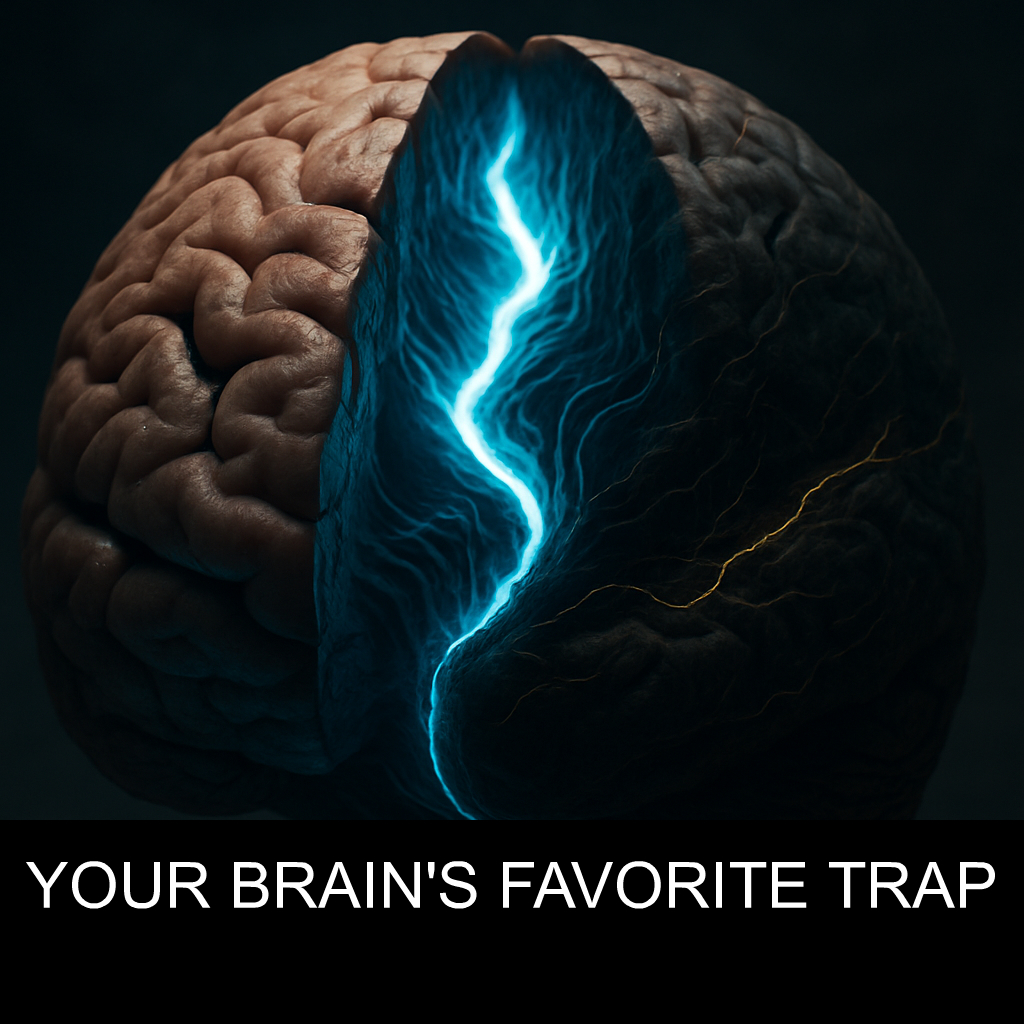
You’re not. You’re fighting geology. The geology of your own mind. In my research into behavioral patterns, I’ve become obsessed with a phenomenon I call The Cognitive Canyon Principle. It’s the single most powerful explanation I’ve found for why we get stuck.
Think of it this way. Your first thought on a subject is like a tiny trickle of water flowing over soft dirt. Barely makes a mark. But the second time you have that thought, the water follows the same shallow path. The hundredth time? The thousandth? Now you have a groove. A millionth time? 🧠
You’ve carved a canyon.
Your Brain’s Addiction to Efficiency (Even When It Hurts)
Your brain is fundamentally lazy. I don’t mean that as an insult; it’s a survival mechanism. It’s the most energy-hungry organ in your body, and its prime directive is to conserve as much fuel as possible. How does it do that? By creating shortcuts.
Neurologically speaking, this is based on a concept I’ve analyzed in countless studies: Hebbian Theory. The simple version is: “neurons that fire together, wire together.” Every time you have a thought, activate a feeling, or perform an action, a specific chain of neurons fires. The more often that specific chain fires, the stronger the synaptic connections between those neurons become. The brain coats that pathway in myelin, an insulating sheath that makes the signal travel faster and more efficiently.
It’s your brain’s version of paving a road. It wants to travel on smooth, fast asphalt, not hack its way through a jungle every time. This is the Cognitive Canyon. It’s the path of least resistance. It takes far less energy for your brain to think the thought it has thought a million times before than to think a new one.
This system has no moral compass. It doesn’t care if the thought is “I am capable and strong” or “I am a complete failure.” It only cares about efficiency.
Where the Canyons Deepen: Anxiety, Habits, and Beliefs
When you start observing everyday social dynamics, you see these canyons everywhere.
Anxiety Loops: A worry is a perfect canyon-carver. You have one anxious thought—”What if I fail the presentation?”—and your brain sends a little trickle of cortisol down that path. You play it again. The groove gets deeper. Soon, just thinking about the presentation automatically funnels your entire emotional state into the Canyon of Failure. This is a terrifyingly effective feedback loop, much like The Neural Threat Echo, where the brain keeps replaying a perceived danger long after it’s gone.
Behavioral Habits: The morning coffee. The after-work doomscroll. The way you react to your partner during a disagreement. These aren’t always conscious choices. They are deep, well-worn canyons that your brain defaults to, especially when you’re tired, stressed, or not paying attention.
Core Beliefs: This is where the canyons become the Grand Canyons of our personality. A belief like, “I’m unlovable,” wasn’t formed in a day. It was carved by trickles of evidence (real or perceived) over years. A critical comment from a parent, a childhood rejection, a failed relationship—each one deepened the groove until it became a fundamental truth about your world. This process is often distorted by memory biases, where we selectively remember evidence that confirms our existing beliefs, a bit like The Rearview Mirror Illusion skews our perception of the past.
Spotting the Canyon in Your Own Life
You can’t navigate a landscape you can’t see. Becoming aware of your canyons is the first, most critical step. Here’s a quick mental checklist based on behavioral studies I’ve analyzed:
- The Automatic Negative Thought (ANT): When you get critical feedback at work, what is the VERY first thought that flashes in your mind? Is it, “This is helpful,” or is it, “See? I’m an imposter”? That’s a canyon.
- The Behavioral Loop: Is there something you do on autopilot? Maybe it’s reaching for a snack when you’re bored, or immediately getting defensive in an argument. Notice the trigger and the automatic response.
- The Story You Tell Yourself: What is the repetitive narrative about your life? “I’m always unlucky.” “Good things don’t happen to me.” “I can’t ever catch a break.” That story is your deepest canyon.
- Your Emotional Default: When faced with sudden change or uncertainty, what is your go-to emotion? Excitement? Or dread? That’s your brain taking the easy path.
Carving New Rivers: How to Escape the Canyon
Here’s the hard truth: you can’t just fill in a canyon. It’s part of your neurological landscape. Trying to fight it head-on with brute force—”I will NOT think this thought!”—often just makes it stronger.
You have to carve a new path. A new riverbed.
This requires immense conscious effort at first. It’s like trying to forge a new trail in a dense forest. The first few times, you’re tripping over roots and pushing branches out of your face. It’s slow and exhausting. Meanwhile, the old, paved six-lane highway is right there, looking very tempting.
But every time you choose the new path—every time you replace the self-critical thought with a neutral one, every time you choose to take three deep breaths instead of snapping back—you clear the new trail a little more. You send another trickle of water down the new path. With enough repetition, you create a new groove. A new default. A new, healthier canyon.
The old paths never vanish completely. They are a part of your history. But the goal isn’t erasure; it’s obsolescence.
You build a better road, a more intentional pathway, until it becomes the brain’s new favorite shortcut. The water will always follow the path of least resistance. Your job is to decide which path that is.