
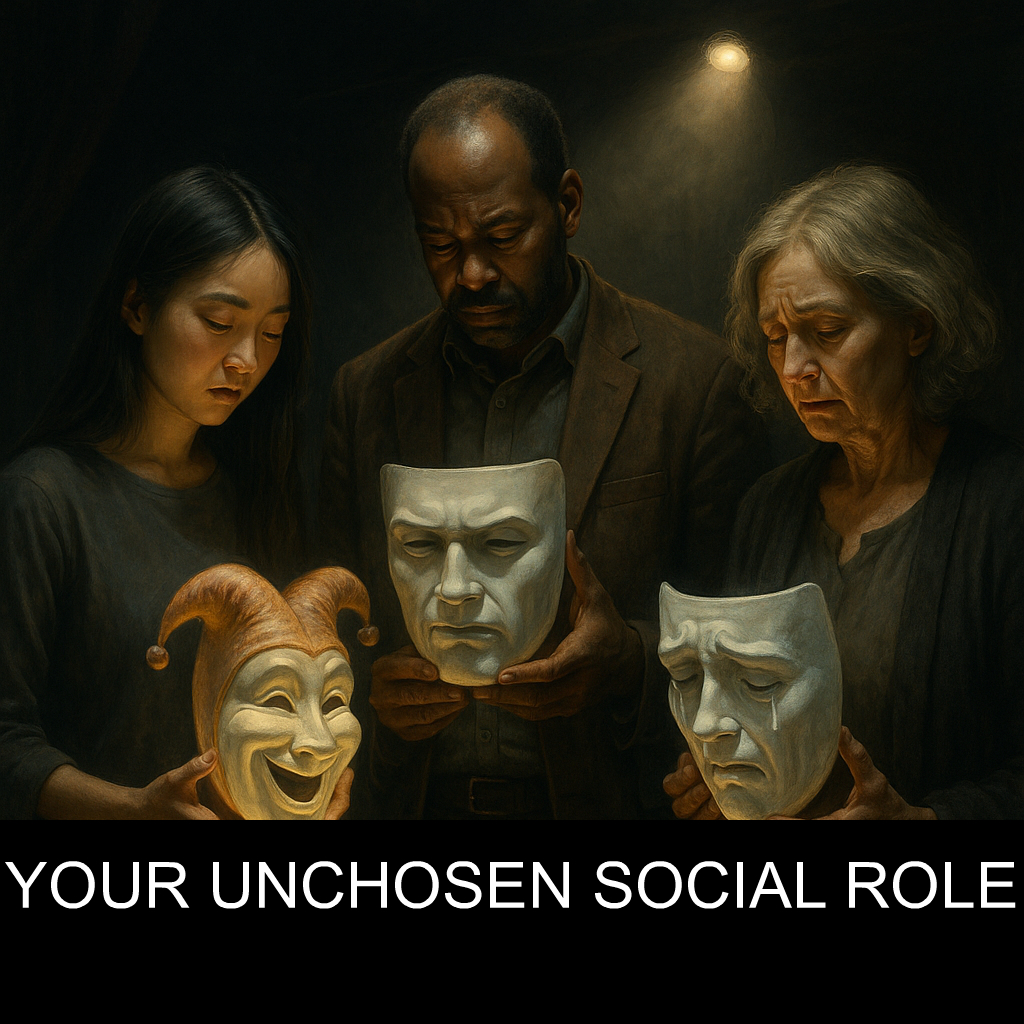

The Implicit Role Casting Effect: The Secret Social Script You’re Forced to Follow
Ever walked into a new job or joined a new group of friends? 🧍
There’s that initial, awkward dance of finding your place. But then, something fascinating happens. Without a single vote or formal discussion, a social order emerges. Roles are assigned. The “funny one” starts cracking jokes. The “organizer” begins planning the next outing. The “quiet observer” settles into the background.
This isn’t an accident. It’s a powerful, unspoken force I call The Implicit Role Casting Effect.
Observed in countless everyday social dynamics, this is the unconscious process where a group assigns a specific role to an individual to serve the group’s needs for stability and predictability. And the most unsettling part? We almost always accept the role without question.
You’re an actor in a play you never auditioned for, handed a script you never got to read.
How the Social ‘Casting Director’ Works
Think of any social group—your family, your team at work, your weekend friend circle—as a living organism. Its primary goal is survival and stability. Chaos is the enemy. Predictability is comfort.
To achieve this, the collective consciousness of the group acts like a casting director. It scans new members, looking for cues. Your first few interactions are your audition. Are you quick with a joke? You might be cast as The Jester. Do you offer a solution to a problem? You’re a candidate for The Problem-Solver.
This process is an aggressive cognitive shortcut. It’s far too much work to analyze every person’s multifaceted personality continuously. So, the group brain slaps a label on you. It’s efficient.
Once you’re cast, confirmation bias kicks in hard. The group will actively look for evidence that supports your role while ignoring everything that contradicts it. This is closely related to what I’ve researched in The Perceptual Commitment Bias, where once our brain commits to a perception, it fights to maintain it. If you’re “the responsible one,” the one time you’re late is seen as a shocking anomaly. If you’re “the flaky one,” the ten times you’re on time go completely unnoticed.
The Common Roles Handed Out (And Their Hidden Traps)
When studying behavioral patterns, I’ve seen these archetypes appear again and again. Each serves a function for the group, but often at a cost to the individual. 🎭
The Scapegoat: Every group needs a release valve for its tension and failures. The Scapegoat is the designated person to blame when things go wrong. This role tragically unifies everyone else… against them. The trap is obvious and brutal.
The Mediator: This person is the group’s emotional glue. They soothe arguments and manage egos. They maintain harmony. The trap? They carry an immense, invisible burden of emotional labor, often neglecting their own needs until they burn out.
The Jester: Laughter is a powerful tool for de-escalation. The Jester uses humor to deflect conflict and lighten the mood. The trap is that they are rarely, if ever, taken seriously. Their valid concerns are often dismissed as another joke.
The Caregiver: The group’s “mom” or “dad.” They remember birthdays, offer support, and generally nurture the group. The trap is that their own need for care is almost completely overlooked. They give, but rarely receive.
The Rebel: This person challenges the group’s norms and pushes back against the status quo. They can be a catalyst for positive change. The trap is that they live on the edge of ostracization, constantly risking social exile for speaking their truth.
Your Brain’s Deep Need for This Social Order
This isn’t some grand, malicious conspiracy. According to behavioral studies I’ve analyzed, it’s a deeply ingrained survival mechanism. Our brains are wired to seek patterns and create predictability from chaos. Assigning roles makes the social world feel less random and, therefore, safer.
It’s a form of social homeostasis. Just as our bodies regulate temperature, a group tries to regulate its emotional and functional state. Roles are the tools. If the group feels too tense, it calls upon The Jester. If it feels fractured, it looks to The Mediator. This drive for balance is powerful, something explored in The Social Thermostat Principle, where we subconsciously adjust our behavior to maintain a desired level of social connection.
The system works for the group’s survival. But does it work for yours?
Breaking the Cast: How to Rewrite Your Own Script
Feeling trapped in a role you didn’t choose is a uniquely frustrating human experience. Escaping it requires conscious, deliberate effort. You have to make the unconscious conscious.
Here’s a practical framework I’ve pieced together from observing successful social recalibrations:
- Step 1: Become the Observer. You cannot change a script you don’t know you’re reading. For one week, just watch. How do people talk to you? What do they ask of you? What expectations are placed upon you? Identify the role. Give it a name.
- Step 2: Execute a Pattern Interrupt. The group expects a specific performance from you. Deny it to them. In a small, low-stakes way, act completely out of character. If you’re The Quiet One, voice a well-thought-out, firm opinion in the next meeting. If you’re The Jester, respond to a serious topic with genuine gravity. This creates a moment of cognitive dissonance that forces the group to re-evaluate you.
- Step 3: Set Verbal Boundaries. Implicit casting thrives in ambiguity. Destroy it with clarity. For The Mediator: “I can see you’re both upset, but I’m not going to get in the middle of this.” For The Caregiver: “I’d love to help, but I don’t have the emotional bandwidth for that today.” It will feel unnatural. It will be uncomfortable. Do it anyway.
- Step 4: Introduce New Evidence. Actively showcase facets of your personality that contradict your assigned role. Talk about your competitive sports league if you’ve been cast as the passive one. Share a complex project you’re working on if you’ve been cast as the simple-minded one. You must consciously provide the group with new data to overwrite the old file they have on you.
You have been assigned a role in every single group you’ve ever joined. Your family, your friends, your career.
The only question is, was it the one you wanted?