
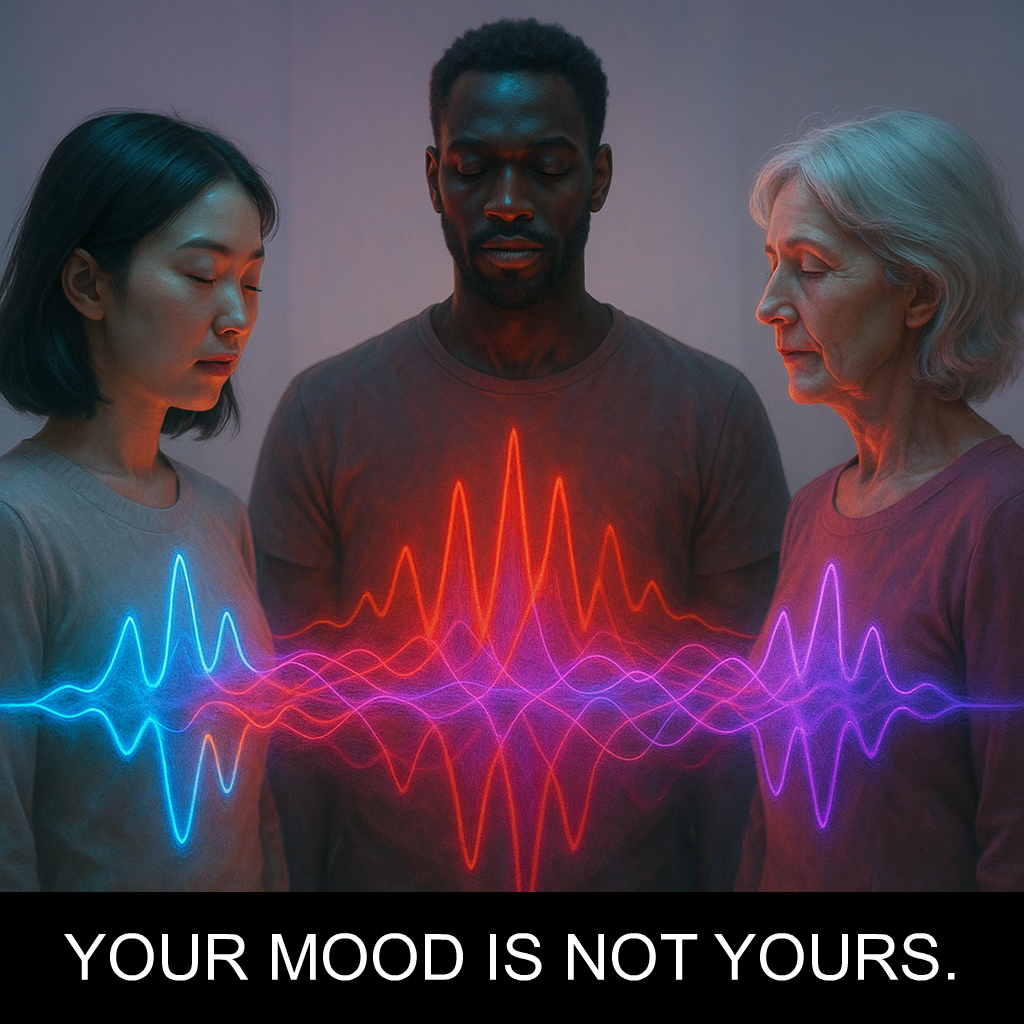

The Proximity Resonance Law: The Invisible Force Controlling Your Moods
Ever walk into a meeting and feel the tension before a single word is spoken? Or join a group of old friends and instantly feel your mood lift, your shoulders relax? 🤔
It’s not magic. It’s a powerful force of social physics I’ve spent countless hours observing.
I call it The Proximity Resonance Law. It’s the invisible, automatic process where the emotional and neurological states of individuals in close proximity begin to sync up. Think of it like tuning forks. If you strike one, a nearby fork of the same frequency will start vibrating on its own, without ever being touched. Humans do the same thing, but with moods, energy levels, and even beliefs.
The Brain’s Secret Wi-Fi Network
So how does this work? When studying behavioral patterns, it’s clear our brains are built for connection. We have systems, like mirror neurons, that are designed to reflect the actions and emotions of others. It’s an ancient survival mechanism. If one person in the tribe felt fear, it was advantageous for everyone to feel it too. Danger might be near.
But in the modern world, this system runs 24/7, picking up signals from everyone around us.
The colleague who is constantly stressed? Their anxiety is broadcasting like a rogue Wi-Fi signal. The calm, confident leader? Their centeredness emits a frequency that can stabilize an entire team. You are constantly receiving these signals, whether you consent to it or not. Your internal state is being subtly, powerfully shaped by the people you share space with.
The Three Channels of Resonance
In my research, I’ve seen this resonance travel through three primary channels. Understanding them is the first step to controlling the effect.
1. The Vocal Channel: It’s not what people say, but how they say it. The pitch, tempo, and volume of someone’s voice directly impacts our nervous system. A fast, high-pitched voice triggers our internal alarm bells. A slow, low-toned voice communicates safety and calm. One person’s panicked tone can infect a whole room with urgency.
2. The Visual Channel: Our brains process non-verbal cues at lightning speed. We unconsciously mimic the facial expressions, postures, and gestures of those around us. Sit in a room full of people with crossed arms and you’ll likely cross yours. This mimicry isn’t just physical; it triggers the corresponding internal emotion. Seeing a frown makes you feel a flicker of sadness yourself.
3. The Cognitive Channel: This is the resonance of shared stories and beliefs. When a group collectively focuses on problems, complaints, and outrage, it creates a powerful cognitive loop. Everyone starts to see the world through that same negative filter. The shared narrative becomes a self-fulfilling prophecy. This is the breeding ground for groupthink and mob mentality. 🧠
The Danger of Your Social ‘Thermostat’
Observed in everyday social dynamics, the people you spend the most time with set your emotional thermostat. Their anxieties become your anxieties. Their ambitions become your ambitions. Their limits become your limits.
This resonance is the bedrock of unspoken group rules and expectations, often leading to what I’ve analyzed before as The Implicit Contract Fallacy, where we assume agreements that were never actually made. We just… resonate into a shared understanding, for better or for worse.
If your inner circle is resonating at a frequency of mediocrity or cynicism, it takes a heroic amount of energy to maintain your own frequency of ambition and optimism.
It’s not about blame. It’s about physics.
How to Control the Frequency
You don’t have to be a passive receiver. You can become the tuning fork that sets the tone for others. You can shield yourself from unwanted resonance. Here’s how:
- Conduct a Resonance Audit: For one week, consciously note how you feel after interacting with the key people in your life. Who leaves you feeling drained and anxious? Who leaves you feeling energized and capable? The data doesn’t lie.
- Become the Broadcaster: Before entering a social setting, decide on the emotional state you want to embody. Calm? Focused? Positive? Intentionally project that state through your posture, tone of voice, and expression. Don’t wait for the room to set your mood; you set the room’s.
- Create Emotional Firewalls: When you feel a negative emotion being broadcasted your way, mentally label it. “That is Sarah’s stress, not my stress.” or “The room’s anxiety is high, but I am calm.” This simple act of observation creates a buffer between their state and yours.
- Take Resonance Breaks: If you’re in an intensely negative environment, physically remove yourself for a few minutes. Go for a short walk. Listen to a piece of music. Reset your own frequency before re-entering the space.
Look at the five people you spend the most time with. Are they tuning you to a frequency you actually want to live on?