
The Perceptual Priority Law: The Secret Brain Filter That Controls Your Reality
You’re in the zone. Deep work. The document is open, ideas are flowing, and you’re finally making progress on that project you’ve been avoiding.
Then you hear it. A faint *ding* from your phone across the room.
Suddenly, the flow state shatters. The entire universe of your focus collapses into a single, nagging question: “Who was that?” Your willpower, which felt so strong seconds ago, is gone. You have to check. You just have to.
This isn’t a personal failure. It’s not a lack of discipline. In my research into the brain’s attentional systems, I’ve seen that this is a powerful, ancient mechanism at work. It’s a biological law you can’t simply ignore.
I call it The Perceptual Priority Law.
So, What Exactly Is This Law?
The Perceptual Priority Law states that your brain will automatically and involuntarily assign the highest priority to sensory input that is novel, emotionally significant, or signals a potential change in your environment.
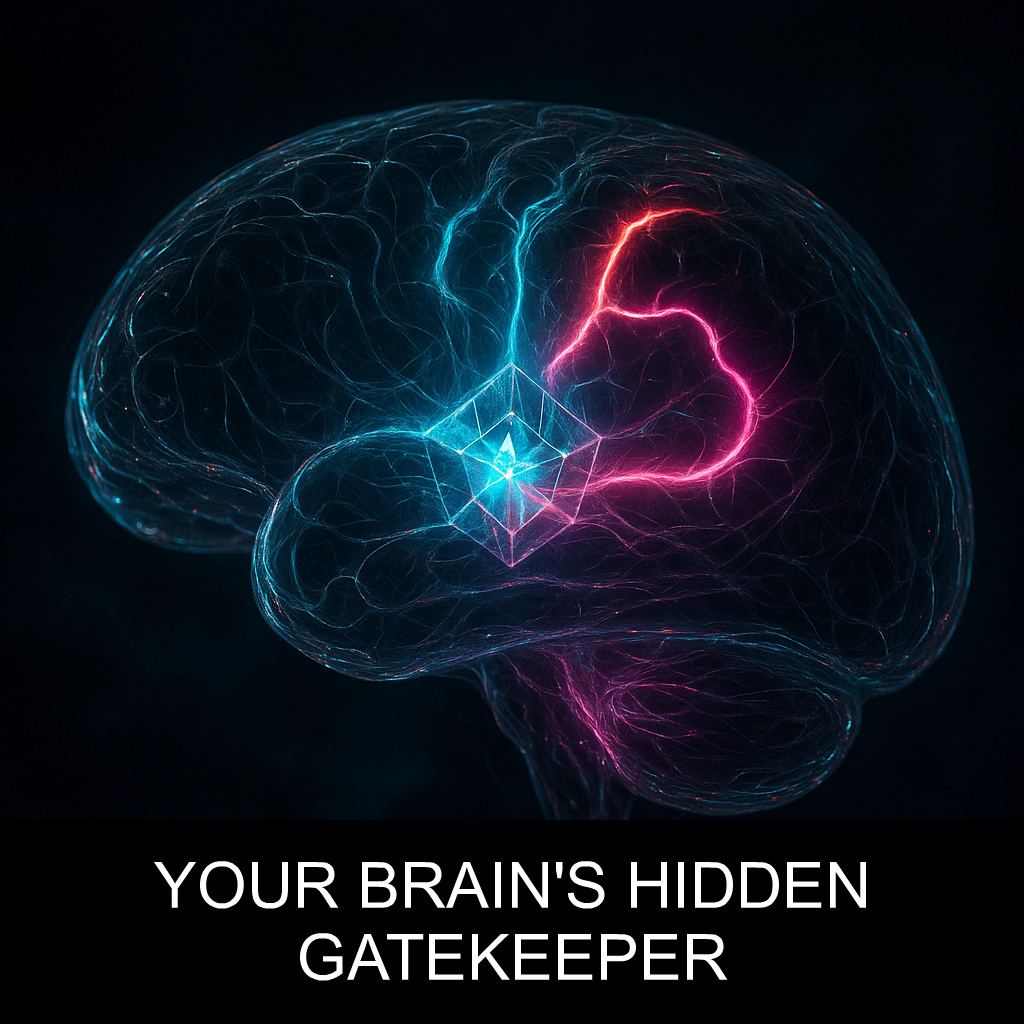
It’s your brain’s built-in gatekeeper. Think of it like a bouncer at an exclusive club. Most information is just background noise, waiting in line. But when something new, exciting, or threatening shows up, the bouncer immediately shoves it to the front, giving it a VIP pass straight to your conscious awareness. 🧠
Observed in neurological studies I’ve analyzed, this is largely managed by a network in the brain called the salience network. Key parts, like the anterior cingulate cortex and the insula, are constantly scanning everything you see, hear, and feel. They ask one simple question: “Is this important enough to interrupt what we’re currently doing?”
A sudden noise? Could be a predator. A flash of bright color? Could be a rare food source. A notification? Could be a social opportunity or a threat to your social standing. Your ancient brain can’t tell the difference between a tiger in the bushes and a text from your boss.
How This Hidden Filter Hijacks Your Focus
The modern world is a relentless assault on this system. Every app, every website, every device is engineered to be a VIP at the door of your mind.
Red notification bubbles, buzzing vibrations, and sensational headlines are all designed to scream “I’M NEW AND IMPORTANT!” to your salience network. They bypass your logical mind and trigger a biological imperative to pay attention.
This constant stream of interruptions creates an environment of perpetual distraction. It’s not just a single interruption; it’s the training of your brain to expect and seek out these interruptions. This constant demand for your attention is a perfect example of what I’ve previously explored as The Manufactured Urgency Trap, where everything feels critical, even when it’s not.
Trying to focus in this environment is like trying to have a quiet conversation at a loud concert. Your brain’s gatekeeper is just too busy letting in every flashy, noisy stimulus to pay attention to the quiet, important work in front of you.
The Anxiety Connection: When The Filter Gets Stuck on “Threat”
This law has a darker side. When you’re under chronic stress or experiencing anxiety, The Perceptual Priority Law gets re-calibrated. The bouncer becomes paranoid.
Instead of just looking for new or exciting things, the filter becomes hyper-sensitive to anything that could possibly be a threat. A neutral look from a stranger becomes a sign of judgment. An unreturned text message becomes proof of abandonment. The sound of your own heartbeat becomes a signal of a panic attack.
Your brain starts giving VIP priority to negative possibilities. It’s a smoke detector that goes off every time you make toast. The system, designed to keep you safe, ends up trapping you in a cycle of fear by prioritizing the very thoughts and sensations that fuel the anxiety. It’s a devastating feedback loop. 😟
Reclaiming Your Attention: How to Train Your Brain’s Gatekeeper
You can’t fire your brain’s bouncer. It’s part of your neurobiology. But you can train it. You can influence what it considers a priority. Based on behavioral patterns I’ve observed in highly focused individuals, the strategy isn’t about more willpower; it’s about managing the environment.
- Drastically Reduce Novelty: This is the most direct method. Turn off all non-essential notifications. Put your phone in another room. Create a work environment that is as boring and predictable as possible. If there are no shiny new things to prioritize, your brain will have no choice but to prioritize the task at hand.
- Practice Mindful Observation: Meditation and mindfulness are direct training for the salience network. You practice noticing a thought or a sound and consciously choosing not to engage. You’re teaching the bouncer, “Hey, I see that, but it’s not a VIP. Let it pass.”
- Prime Your Intentions: Before starting a task, state your intention clearly. “For the next 45 minutes, my priority is finishing this report.” This primes your brain’s gatekeeper to be on the lookout for report-related thoughts and ideas, giving them a higher priority than random distractions.
Your attention isn’t something you *have*; it’s something you *direct*. And the quality of your life is determined by what you consistently direct it toward.
So, who’s holding the remote?