
The Quicksand Commitment Trap: The Hidden Brain Script That Keeps You Stuck
Ever finished a terrible movie just because you were already an hour in? Or poured more money into a failing business project, telling yourself you’re “too invested to quit”?
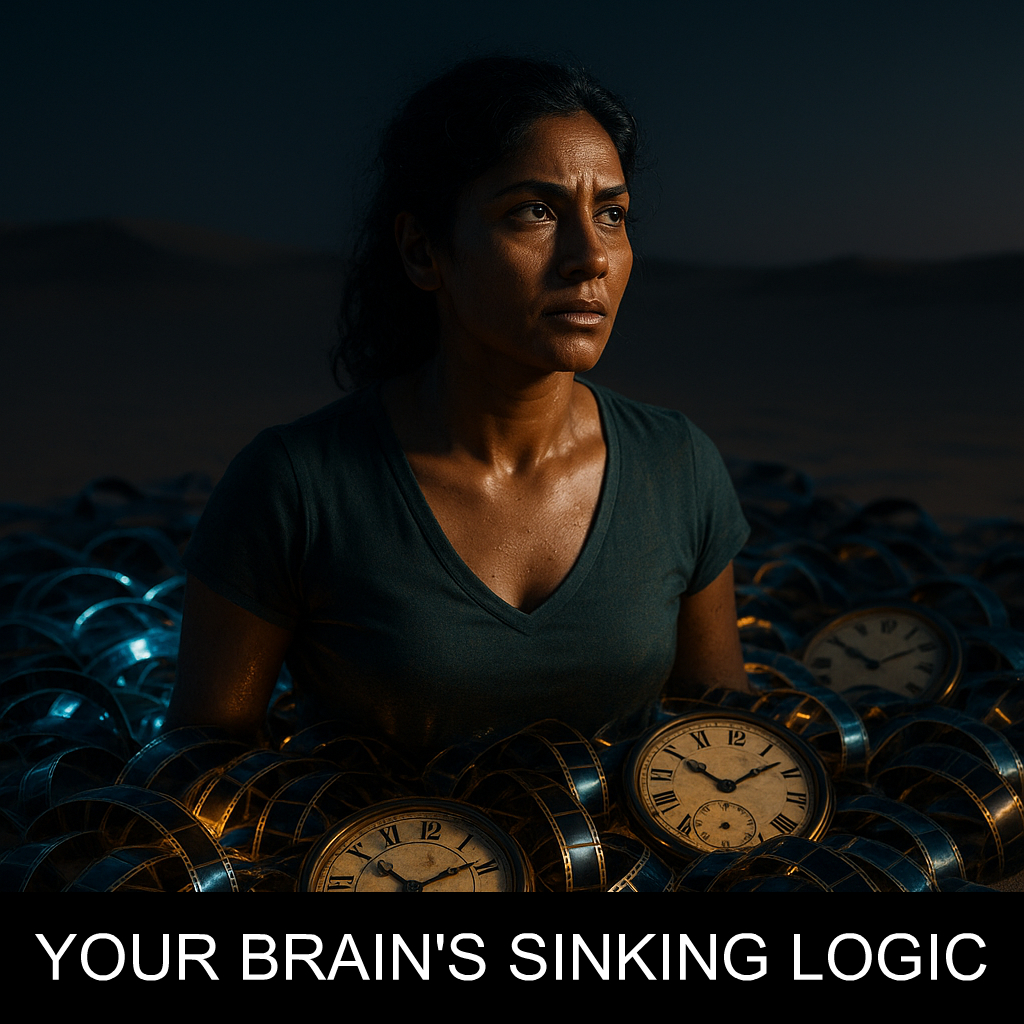
If you nodded, you’ve felt the pull. It’s a subtle, downward tug. A cognitive quicksand.
In my research into the illogical patterns of human decision-making, this is one of the most powerful and destructive I’ve ever come across. I call it The Quicksand Commitment Trap. It’s the brain’s secret script that says: “You can’t stop now. Look how far you’ve come.”
It’s a lie. A dangerous one. 🤫
What Is This Hidden Script? A Deep Dive
Academics call this the “Sunk Cost Fallacy.” But that sounds sterile. It doesn’t capture the feeling of sinking, of being slowly consumed by a past decision.
Here’s the mechanism. Our brains are fundamentally wired to avoid loss. Daniel Kahneman and Amos Tversky’s work on Prospect Theory showed this brilliantly—the pain of losing $100 feels far more intense than the pleasure of gaining $100.
When we invest time, money, or emotion into something, that investment becomes a possession. If we walk away, our brain codes it as a painful loss. To avoid that pain, it creates a new, irrational goal: to justify the initial investment, even if it means throwing more resources into the fire.
It’s an ego-defense system. Admitting a past decision was wrong forces us to confront our own fallibility. It’s easier to double down. To keep digging.
The Trap in Action: Where You’re Sinking Without Realizing It
This isn’t just about business or finance. When studying behavioral patterns, I see this trap everywhere. It’s a ghost in the machine of our daily lives.
In Your Career: You stay in a job that makes you miserable. Why? Because you spent four years getting the degree and another five climbing this specific ladder. Quitting now would mean all that effort was a “waste.”
In Your Relationships: You cling to a partnership that has clearly expired. The logic? “But we’ve been together for seven years. We have so much history.” The history becomes an anchor, not a foundation.
In Your Projects: You keep working on a novel, a piece of art, or a home renovation that you no longer feel passionate about. You’ve already poured 200 hours into it. The thought of starting something new is overshadowed by the perceived “waste” of those hours.
Our past choices become heavy chains, and we often mistake their weight for value. We’re so focused on the road behind us that we fail to see we’re driving off a cliff. This is related to a cognitive glitch I’ve analyzed called The Rearview Mirror Illusion, where past events are given far too much influence over present decisions.
The Brain’s Faulty Math: Why ‘Waste’ Is a Four-Letter Word
Think about it like this. You pay $20 for a ticket to a concert. An hour in, the band is awful. You’re having a terrible time. You have two choices:
- Stay and endure two more hours of bad music, wasting your time to “get your money’s worth.”
- Leave and use the next two hours to do something you actually enjoy.
The $20 is gone either way. It’s a sunk cost. It should have zero bearing on your decision *from this moment forward*. Yet, most people stay. They pay for a bad experience twice: once with money, and again with their time and happiness.
The Quicksand Commitment Trap tricks you into trying to save the un-savable. Your brain isn’t solving a problem for your future self; it’s trying to retroactively justify the choices of your past self. It’s a fool’s errand. 🧠
How to Escape the Quicksand: A Practical Toolkit
Recognizing the trap is the first step. Climbing out requires a conscious override of your brain’s default programming. It’s not easy, but it is simple.
Observed in people who make consistently good decisions, there are a few mental tools they use to sidestep this trap entirely:
- Ask the Amnesia Question: Imagine you woke up today with no memory of this project, investment, or relationship. Knowing only what you know *now* about the situation, would you choose to invest your time and energy into it starting today? If the answer is no, you have your real answer.
- Focus on Future Costs vs. Past Costs: Stop thinking about what you’ve already lost. That’s history. Instead, calculate the future price. “If I stay in this job for another year, what will it cost me in mental health, missed opportunities, and happiness?” Frame the decision around what you will lose going forward, not what you’ve already spent.
- Get an Uninvested Opinion: Talk to someone who has no emotional or financial stake in your situation. They aren’t in the quicksand with you. They can see the solid ground you can’t. Their logical, outside perspective is a lifeline.
- Set a “Kill Switch” in Advance: For future projects, decide on your failure metrics *before* you start. For example: “If this business isn’t profitable by X date,” or “If I don’t get Y result after Z effort, I will walk away.” This pre-commitment protects your future self from the emotional pull of sunk costs.
The resources you’ve spent are gone. They were tuition paid to the school of life. You can either learn the lesson and move on, or stay stuck in the classroom forever.
The costs have already been paid. The only real question is: what is the price of your future?