
The Rearview Mirror Illusion: Why Your Brain Lies About Your Past Decisions
The Sweet Lies We Tell Ourselves
Ever look back at a disastrous relationship and say, “Well, at least I learned what I don’t want in a partner”? Or think about a failed business venture and conclude, “It was a necessary failure that taught me resilience”?
It sounds so wise. So mature.
It’s also, in many cases, a complete fabrication. A sophisticated lie your brain tells you to protect you from a painful truth.
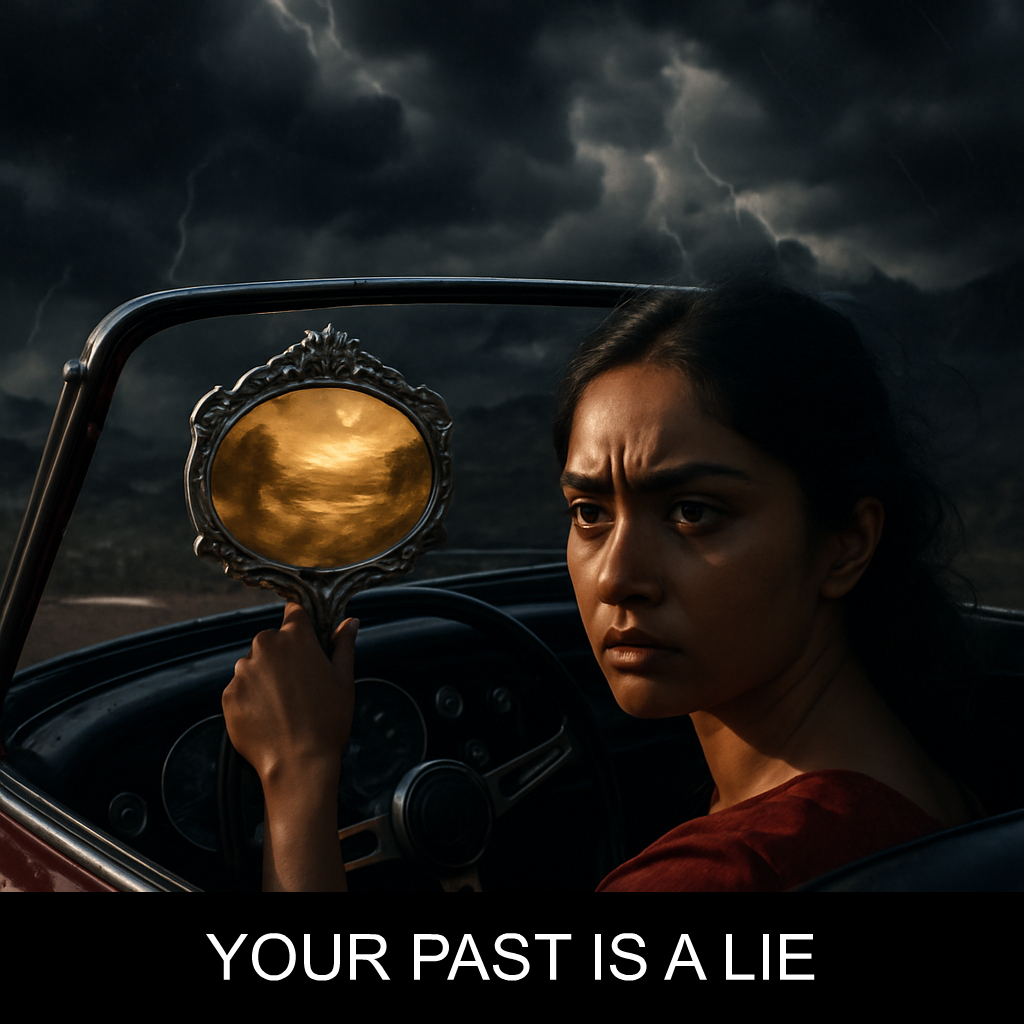
In my research into cognitive patterns, I’ve become obsessed with this phenomenon. I call it The Rearview Mirror Illusion. It’s our mind’s tendency to retroactively edit our memories of past events, reframing poor decisions and negative outcomes as valuable, intentional, or unavoidable lessons. The brain is essentially a spin doctor for your past self. 🧐
It’s not about learning from your mistakes. That’s healthy. This is different. This is about pretending the mistake wasn’t a mistake at all, but a cleverly disguised lesson you were smart enough to sign up for.
The Ego’s Personal Historian
Why does this happen? Simple. Your ego is fragile.
Admitting you wasted five years on the wrong person, or lost your savings on a foolish investment, is a direct hit to your self-concept. It forces you to confront the idea that you might not be as sharp or intuitive as you’d like to believe.
That hurts. A lot.
So, the brain’s defense mechanism kicks in. It’s like an internal PR agent that gets to work rewriting the press release on your past. That catastrophic decision? It’s now reframed as a “character-building chapter.” That glaring red flag you ignored? It was a “subtle clue in a complex situation.”
This illusion is the direct consequence of a powerful psychological force: cognitive dissonance. It’s the profound discomfort we feel when our actions (making a bad choice) clash with our beliefs about ourselves (“I am a smart, capable person”). To resolve this tension, something has to give. Since you can’t change the past action, your brain changes your perception of it. It’s the path of least resistance.
Where the Illusion Steers You Wrong
Observed in everyday social dynamics, this isn’t a harmless quirk. It has real, damaging consequences. It keeps you stuck.
In Relationships: You justify staying in a toxic situation far too long because, in hindsight, you tell yourself it “taught you strength.” The illusion papers over the emotional damage, making you more likely to tolerate similar bad behavior in the future because your brain has already built a justification narrative for it. It’s a way of rationalizing poor choices that may have been locked in by something I’ve studied called The Perceptual Commitment Bias, where our initial decision colors all future information.
In Careers: People rationalize staying in a dead-end job for a decade by saying, “The stability was important for my family at the time.” While partially true, it’s often a story that masks the fear of change. By framing the inaction as a noble sacrifice, they avoid confronting the regret of not pursuing their true ambitions. It justifies passivity.
In Finances: This is a classic. “Losing $10,000 on that crypto coin was the best tuition I could have paid for. It taught me about market volatility.” This narrative transforms a reckless gamble into a calculated educational expense. The danger? It doesn’t actually instill a better decision-making process; it just gives you an ego-soothing story for failure, making you susceptible to the next “sure thing.”
The Glitch in Your Personal Timeline
Think of your memory not as a high-definition video recording, but as a wiki page that you can edit at any time. The Rearview Mirror Illusion is you, the editor, constantly going back and cleaning up messy paragraphs to make the protagonist—your past self—look better.
This isn’t just about feeling good. According to behavioral studies I’ve analyzed, this process has a profound effect on our future. If you constantly reframe your failures as successes-in-disguise, you never truly integrate the raw, painful data from the failure itself. You learn a sanitized, fictional version of the lesson.
Real learning is painful. It requires you to look at a decision and say, “That was a mistake. It was based on flawed information and emotional impulse. It hurt, and I was wrong.”
The illusion says, “That was a brilliant move, executed imperfectly, that led to an invaluable outcome I couldn’t have achieved any other way.” See the difference? One promotes growth, the other promotes repetition of the same underlying error patterns.
Breaking the Illusion: How to See the Road Behind You
You can’t stop your brain from trying to protect your ego. It’s an automatic process. But you can become a conscious observer of it. You can learn to spot the spin and choose a more honest narrative. ✨
Here’s how to start cleaning the mirror:
- Conduct a ‘Decision Autopsy’: Take a past decision you’ve been reframing. Write down, with brutal honesty, what you knew *at the moment of the decision*. Not with hindsight. What were the facts? What were the emotions? What were the obvious red flags you chose to ignore? Don’t add the outcome yet. Just analyze the decision itself.
- Separate the Lesson from the Justification: Yes, every experience holds a potential lesson. But a justification is a story designed to erase the mistake. The lesson is what you learn *from* the mistake. Acknowledge the pain, loss, or foolishness first. Feel it. Then ask, “Given this outcome, what will I do differently next time?” Don’t skip to the positive takeaway without honoring the negative reality.
- Practice ‘Ego-Neutral’ Journaling: Write about past events like a detective logging evidence. No flowery language. No silver linings. Just the facts. “I lent money to someone who didn’t pay me back. I felt angry and foolish.” That’s it. Stripping away the narrative-building pressure allows you to see the event for what it was, not what your ego needs it to be.
Your past is not a storybook written to make you the hero. It’s a data log.
Stop editing the data to fit your preferred story, and start using it to build a better future.