
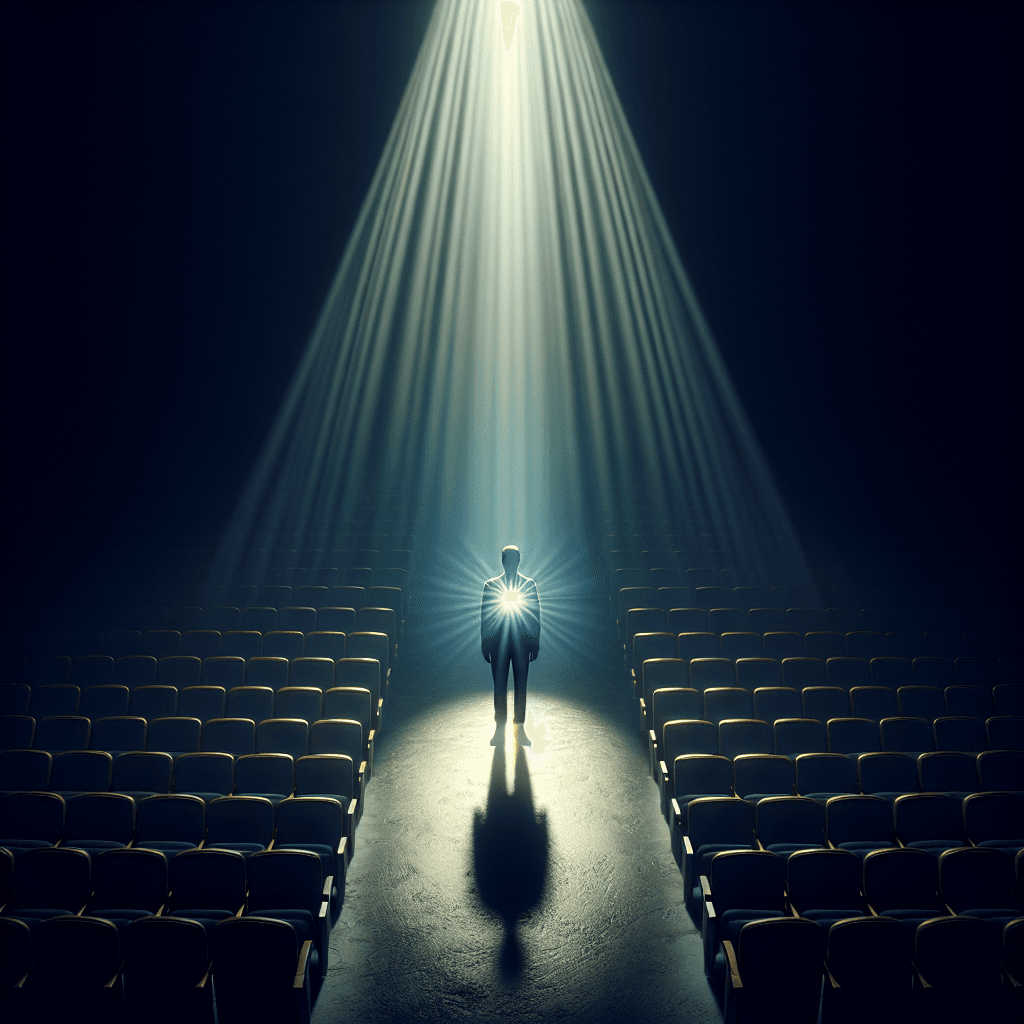

The Secret Spotlight Effect: Why Nobody is Watching You (And How to Use This to Your Advantage)
You feel a drop of coffee land on your crisp, white shirt. It’s tiny, but to you, it feels like a giant beacon of failure. ☕
Suddenly, the entire coffee shop seems to go silent. Every eye is on you. You can feel their judgment, their smirks. Your brain screams, “Everyone thinks I’m a mess!”
But what if I told you a secret? Nobody noticed. Or if they did, they forgot about it 0.5 seconds later.
This intense, irrational feeling of being under constant observation isn’t just in your head—it’s a specific trick your brain plays on you. It’s a hidden cognitive bias known as The Spotlight Effect.
What is The Hidden Spotlight Effect?
The Spotlight Effect is the powerful tendency to overestimate how much other people notice your appearance or behavior.
In your mind, a spotlight follows you everywhere, highlighting your every flaw, mistake, and awkward moment. In reality, that spotlight is an illusion. You’re the only one who sees it.
This isn’t just a theory; it’s been proven. Psychologists at Cornell University conducted a famous experiment where they had students wear an embarrassing Barry Manilow t-shirt into a crowded room. The student wearing the shirt was convinced that at least 50% of the people noticed. The reality? Less than 25% did.
Your brain doubles the number of people you think are paying attention to you. Let that sink in.
The Brain’s Deception: Why We Fall For It
This mental glitch is rooted in a simple truth: you are the center of your own universe. Your thoughts, feelings, and actions are intensely vivid to *you*. You know you have a tiny stain on your shirt, so you assume it must be just as obvious to everyone else.
This is a form of egocentrism. Your brain has trouble separating your own subjective experience from an objective reality. It can’t easily compute that other people are just as busy being the main characters in their *own* movies.
They aren’t guest stars in yours. They’re worried about their own hair, the email they need to send, or the stain on *their* shirt.
The Real Cost of a Fake Audience
This might seem like a small, harmless bias, but its effects are devastating. The Spotlight Effect is the fuel for social anxiety. 😥
It’s the hidden force that stops you from:
- Speaking up in a meeting.
- Going to the gym alone.
- Wearing that bold outfit you love.
- Introducing yourself to someone new.
You are constantly editing and censoring your true self to please a phantom audience that doesn’t even exist. You’re living your life on defense, trying to manage perceptions that no one is even forming.
Ironically, when you try too hard to control how others see you, you can trigger the exact opposite of what you want. This is a fascinating psychological trap in itself, sometimes called The Boomerang Effect, where persuasion attempts backfire.
How to Turn Off the Spotlight and Reclaim Your Control
Understanding the bias is the first step. Actively fighting it is how you gain true freedom. You don’t need years of therapy; you just need a few secret mental triggers to pull.
1. The Reality Check Technique
Think back to yesterday. Can you remember the specific shoes a stranger was wearing in the grocery store? The hairstyle of your barista? The brand of the laptop of the person next to you at work?
Probably not. You remember almost nothing about the details of strangers. Now, apply that same logic to yourself. That’s exactly how much attention they are paying to you. Almost none.
2. The 10-10-10 Rule
When you do something you perceive as embarrassing, pause and ask yourself these three questions:
- Will this matter in 10 minutes? (Maybe)
- Will this matter in 10 months? (Absolutely not)
- Will this matter in 10 years? (You won’t even remember it)
This simple rule shatters the emotional intensity of the moment and puts things into their proper, insignificant perspective.
3. Shift Your Focus Outward
The Spotlight Effect is a disease of inward focus. The cure is to focus outward. When you enter a room, instead of thinking, “What do they think of me?” switch your brain to, “Who can I learn about?”
Be curious. Ask people questions. Listen to their answers. When you become genuinely interested in others, you forget to be self-conscious. You can’t be the star of the show if you’re busy being the interviewer. ✨
Your Action Plan: A Checklist for Freedom
Here is your immediate checklist to use the next time you feel that imaginary spotlight burning down on you. This is your path to taking back control.
- Acknowledge & Name It: The second you feel that wave of self-consciousness, stop. Say to yourself, “Ah, this is just the Spotlight Effect. It’s not real.” Naming the demon is the first step to taming it.
- Perform a Reality Check: Remind yourself of the Barry Manilow experiment. Halve the number of people you think are watching. Then halve it again. The real number is probably zero.
- Shift Your Mental Focus: Find something or someone in the room to be curious about. Get out of your own head by getting into the world around you.
- Take the Action Anyway: Ask the question. Wear the outfit. Go to the party. Every time you act despite the feeling, you weaken the bias. You are retraining your brain, one brave action at a time.
The secret is realizing the cage was never locked. The audience was never there. The spotlight was just a flashlight you were holding yourself, and you can turn it off whenever you want.



Pingback: The Pratfall Effect - 99% Brain Up
Pingback: The Emotional Contagion Effect - 99% Brain Up
Pingback: The Decoy Effect - 99% Brain Up